

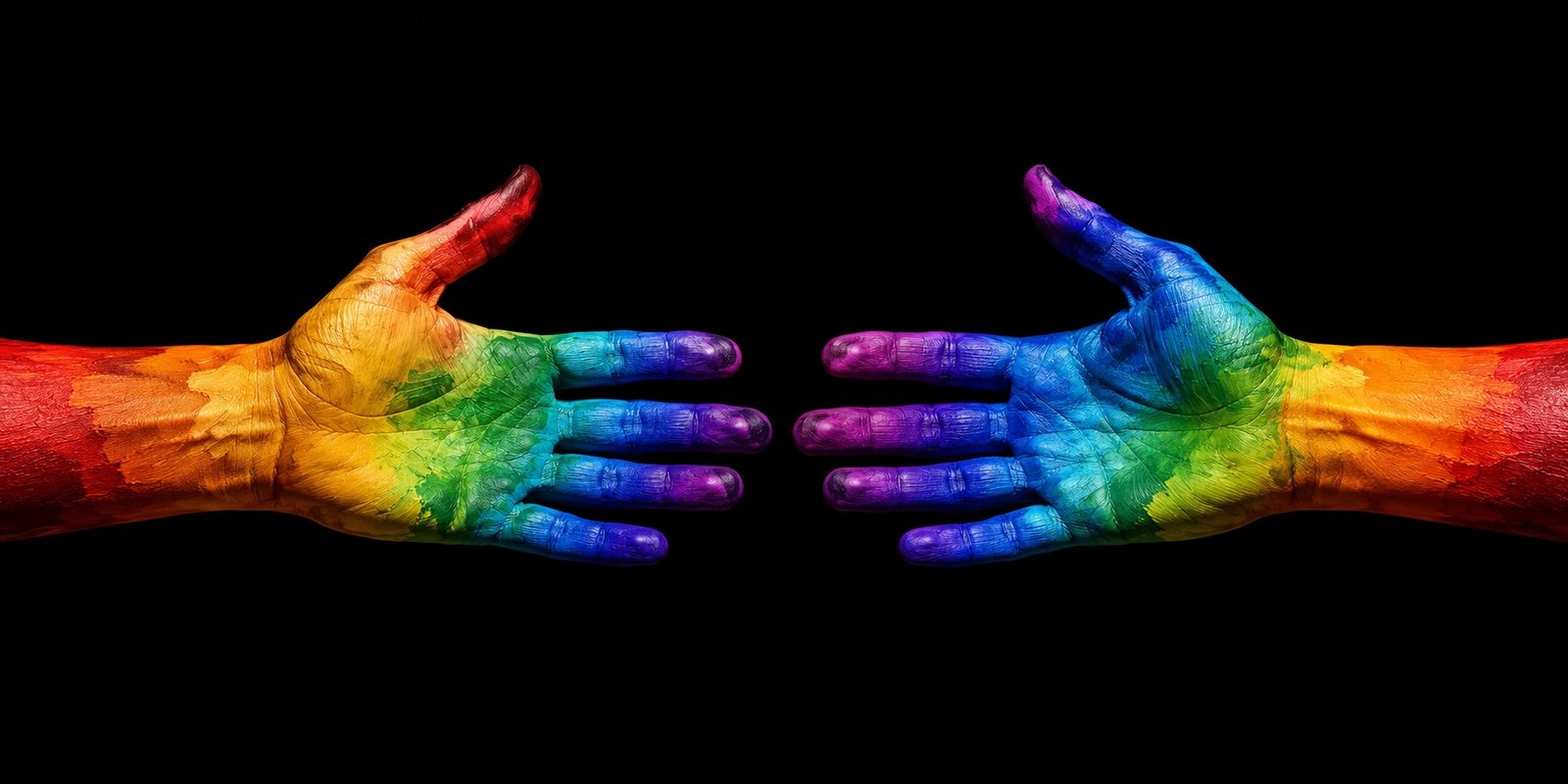
I cried in my car this week. Like a full, ugly cry. Windows up, in a parking lot, not moving.
The song that did it? “Testify to Love,” a song I know every single word to. A song I used to sing in church, with my hands raised, completely convinced it meant something. It did mean something. Just not what I thought.
Let me back up.
I spent 35 years in church. Eleven of those on staff as a pastor. I was one of the people at the front. The one who was supposed to have the answers. The one who, if I’m honest, participated in a theology that told queer people they were broken … and called it love. I didn’t think I was doing harm. I genuinely didn’t. That’s the scariest part.
“Testify to Love” was everywhere back in the day. Avalon released it in 1997, and it sat at the top of the Christian charts forever. It starts with “all the colors of the rainbow.” We sang it without a single hint of irony. In a world where rainbow flags were treated like enemy flags. In a world where gay kids sat in our youth groups terrified of being found out.
The song is basically a promise. “For as long as I shall live, I will testify to love.” Over and over. Then this line that hits different now: “I’ll be a witness in the silences when words are not enough.” The churches I was a part of were fluent in silence. Silent when queer teenagers cried alone. Silent when gay adults got quietly shown the door. Out of the church. Out of their families. Out of any version of faith that still made sense. We sang about being a witness in the silences … and then we were silent in exactly the wrong way.
“Every hand that reaches out to offer peace.” We sang that too. Hands that, in the same week, signed letters opposing marriage equality. Hands that handed queer people pamphlets about conversion ministries. Reaching out, sure … just not with peace.
So here’s what I didn’t know until recently. One of the men who wrote and sang that song, Michael Passons, was living all of it from the inside. He was gay. He was hiding. He sang those words for years while hiding who he truly was. The church celebrated his voice and silenced those words for years while hiding who he truly was. The church celebrated his voice and silenced his truth at the same time. When Avalon found out, they showed up at his house and told him he was no longer in the group. He was ousted for being gay and refused to attend conversion therapy.
That song kept playing on Christian radio. He didn’t.
Think about that for a second. A gay man singing “I will testify to love” every night to arenas full of people who would have rejected him completely if they had known who he was. Singing “every corner of creation lives to testify” while one very important corner of his own creation had to stay in invisible. That’s not just irony. That’s a specific kind of pain that a lot of queer people who grew up in the church know from the inside.
Fast-forward to now. May 2026. Passons and Grammy-nominated country artist Ty Herndon just released a new version of “Testify to Love,” joined by an all-star chorus of LGBTQ+ artists and advocates. Herndon is gay. Passons is gay. Former Avalon member Melissa Greene is featured on it too, a straight woman who chose to show up fully as an ally.
Melissa says it herself: “We sang it night after night to arenas of people. Then Michael was kicked out of the group for being gay. The song kept going. He didn’t.”
When I heard the new version … that’s when I lost it in the parking lot.
Because “all the colors of the rainbow” means something different when the person singing it isn’t hiding anymore. “Every dream that reaches out to find where love begins” lands differently when the person dreaming doesn’t have to pretend. “All the hope in every heart will speak what love has done.” Every heart. Not the approved hearts. Not the hearts that fit the theology. Every one.
That’s the version of this song that should have always existed.
I’m a Gen X former pastor who has spent the last few years trying to unlearn things I spent decades teaching. Deconstruction is not a clean process. It’s not a podcast you listen to and suddenly you’re enlightened. It’s grief. Real grief. Grief for people you hurt without knowing you were hurting them. Grief for the version of yourself who thought certainty was the same thing as truth.
So hearing this song again, sung this way, but these people… it hit somewhere deep.
Passons described it as more than a cover. He called it a restoration. That word is doing a lot of work and earned every bit of it. This is not a song that got repurposed. It’s a song that finally got to be what it always should have been. Herndon put it simply: “Faith, identity, and love belong to everyone. No exceptions.”
That sentence would have made me uncomfortable 15 years ago. Now it sounds like the most obvious thing in the world.
I want to be careful here. One song doesn’t fix anything. The harm done to queer people in the name of Jesus is not a minor thing. It’s not something a beautiful three-minute recording washes away. People lost their families. They lost their faith. Many lost their lives. A song can’t carry all of that away.
Sometimes healing doesn’t arrive all at once. Sometimes it shows up in a parking lot, through a pair of earbuds, in a moment you weren’t expecting. Sometimes it’s just the smallest crack of light under a door you thought was locked forever.
That’s what this felt like to me. A crack of light.
Melissa wrote that what’s changed is that they’ve all learned how to stand inside the music fully, as themselves. She called it “the song finally telling the truth.”
If you grew up in church and you’re queer, you know what it’s like to sit in a room full of people singing about love while feeling like that love had an asterisk next to your name. You sang “I will testify to love” and wondered if you were even allowed to. You heard “every corner of creation lives to testify” and quietly wondered if your corner counted. That wound doesn’t heal fast. Honestly … I’m not sure if it ever fully heals.
There’s something that happens when the very thing that was used to exclude you gets picked up and reclaimed. When the song that played while people like me looked the other way gets sung by the people we failed. That’s not small. That’s a kind of justice that doesn’t arrive through legislation or protest. It arrives quietly, in your chest, while you sit in a parking lot crying.
I’m a former pastor who got a lot of things wrong. I’m still figuring out what it means to do better. But I do know this: When I heard those voices singing “for as long as I shall live, I will testify to love”… and finally meant every word of it … something shifted.
If nobody ever told you that your corner of creation counts … It does. It always did. The song just finally caught up. If you haven’t heard the song yet, it just released on May 15. Check it out.
