

There is something almost scandalous about a ballet with no orchestra.
You walk into the War Memorial Opera House expecting the ritual. The low murmur rising from the pit. A stray violin testing the air. The shimmer of strings tuning against one another before the conductor lifts his hands. That velvet swell that signals the evening is about to begin.
Instead, you look down and it is completely dark.
No musicians shifting in their seats. No conductor stepping into light. No glow rising from beneath the stage.
For a brief moment, it feels as though something essential has been removed. Then it becomes clear that the absence is intentional. But in this case, the darkness is more a recalibration than a real void.
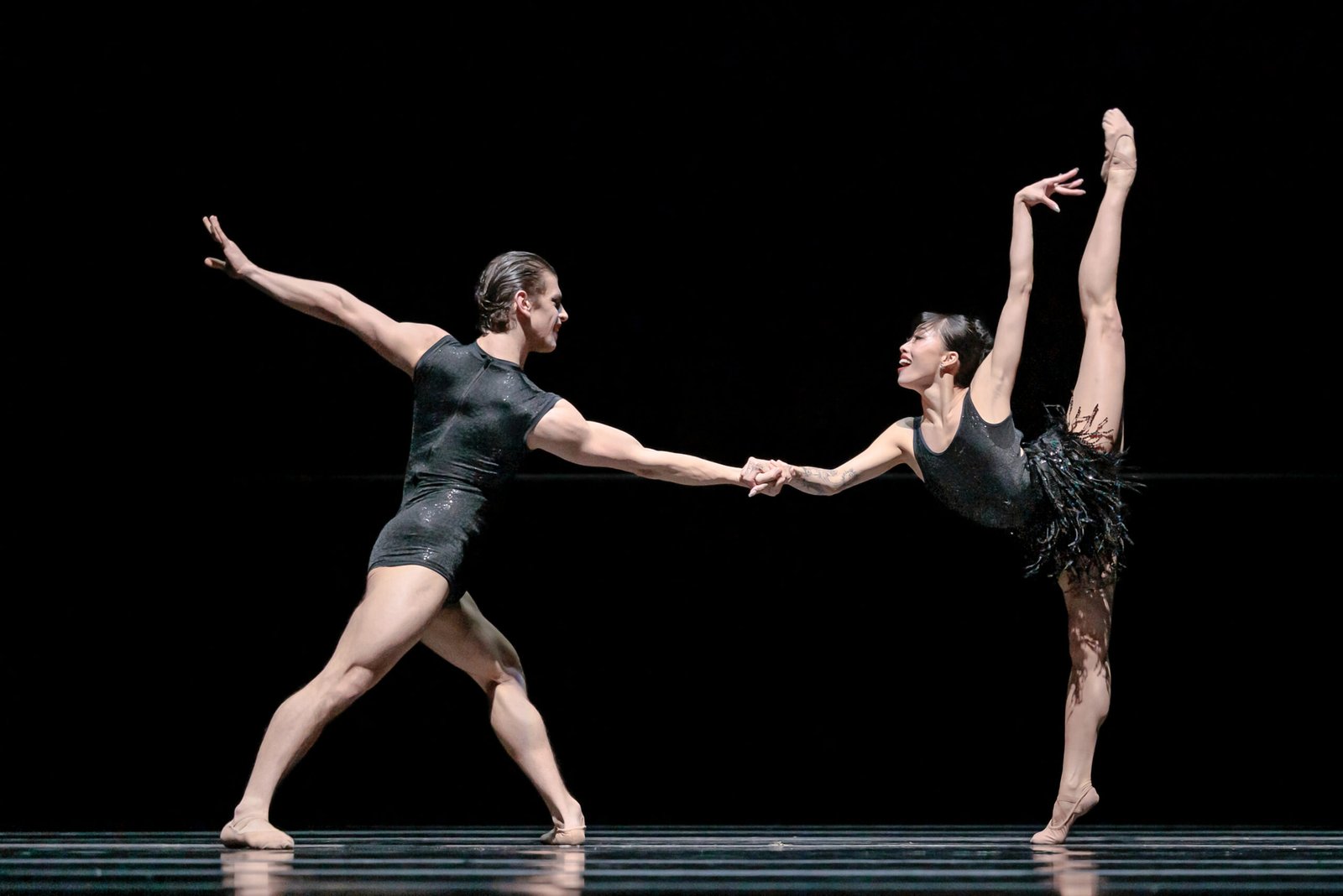
San Francisco Ballet’s The Blake Works, running February 27 through March 8, opens not with symphonic grandeur but with space and electronic sound. You can hear the room settle into itself. You can hear breath. Then James Blake’s voice enters, filtered and intimate, hovering somewhere between human and machine. It fills the theater without overwhelming it. William Forsythe allows the choreography to meet that sound without adornment. There is no orchestral cushion, no romantic swell to guide the emotional arc. There are only dancers and a pulse.
If one has been waiting for contemporary ballet in San Francisco to feel fully situated in the present tense rather than framed by ceremony, this is that moment.
Forsythe’s command of classical vocabulary remains unmistakable. He understands ballet’s architecture so completely that he can tilt it, fracture it, and extend it without destabilizing its core. Lines stretch just beyond expectation. Hips angle slightly off center before resolving. Classical phrasing dissolves into angular modernity and then reconstitutes itself with clarity. The choreography feels sentient, alert to the music and to the bodies carrying it.
The program unfolds in three sections: Prologue, The Barre Project, and Blake Works I. The progression mirrors the musical build, beginning in restraint and gradually accumulating momentum.
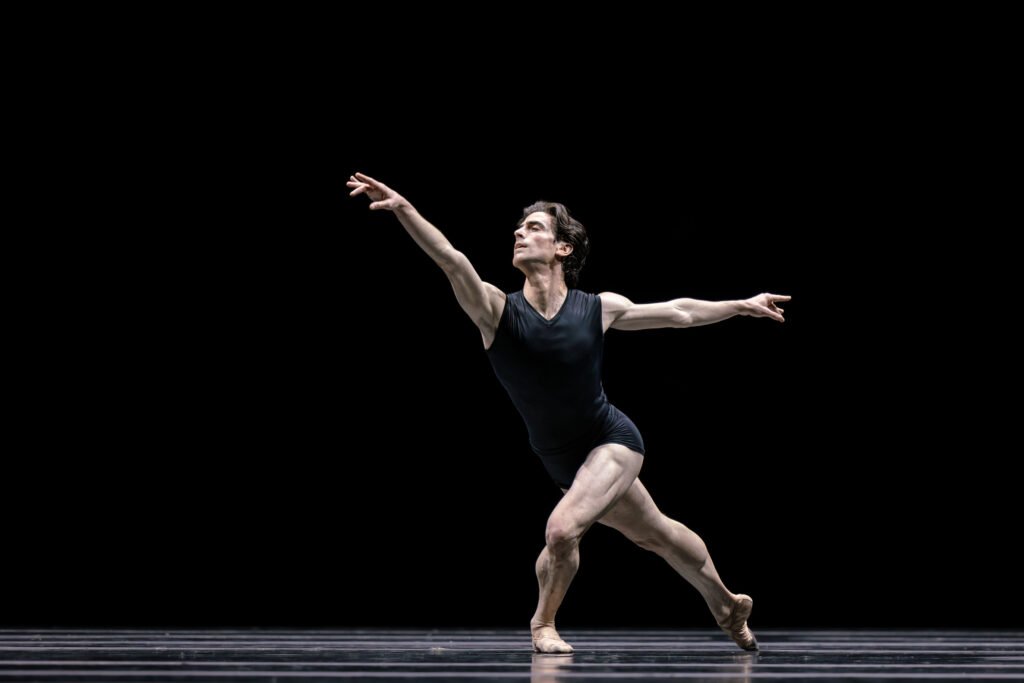
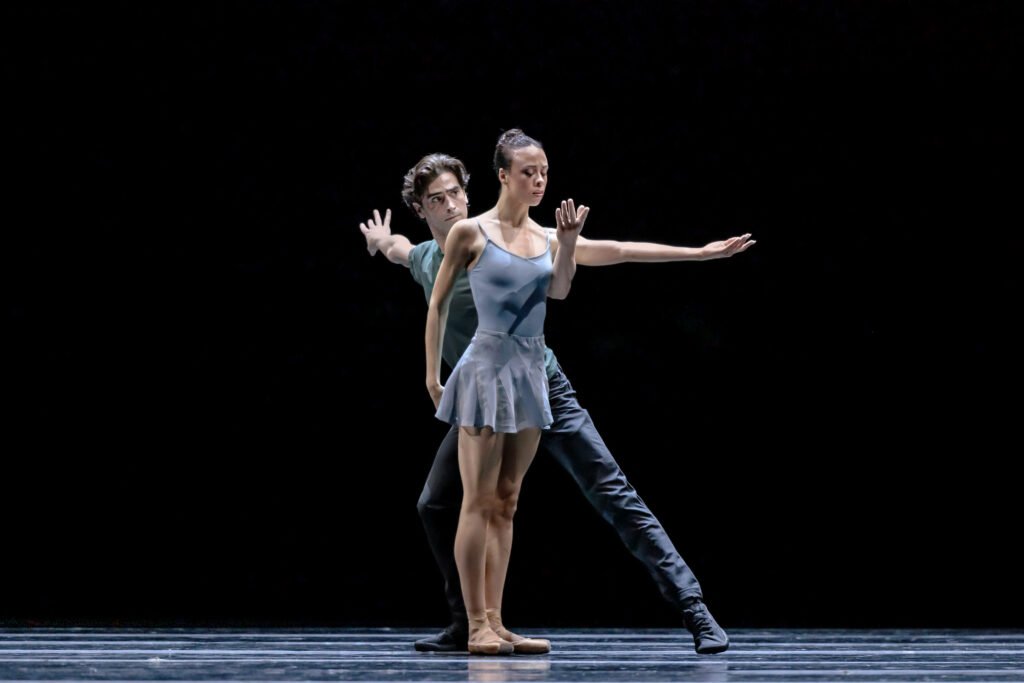
In Prologue, the spareness of Blake’s score alters the way the dancing registers. Without an orchestra underlining transitions, the mechanics become visible. One hears the brush of a foot across the floor, the quiet impact of a landing, the breath taken before a turn. Much of the first half is danced flat-footed, without pointe shoes lifting the body into classical illusion, and that choice shifts everything. The dancers appear lower to the ground, more weighted, more immediate. Ballet looks less lacquered and more athletic, less porcelain and more muscle. The absence of pointe strips away a layer of sheen and replaces it with something rawer, closer to the body’s actual effort.
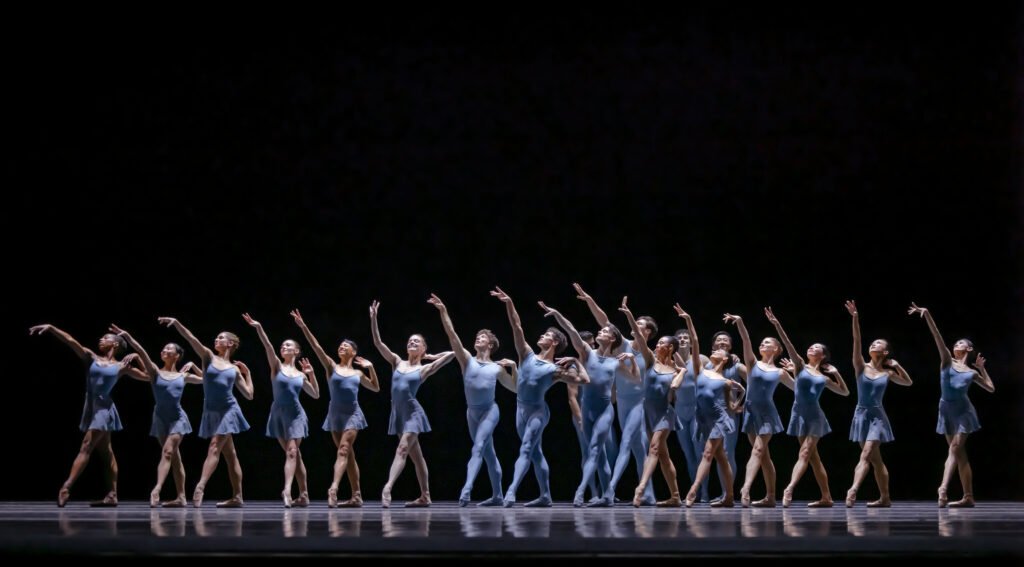
The costumes reinforce that clarity. The dancers wear muted blue leotards with short pleated skirts that move as quickly as the choreography itself, catching air and settling without fuss. Under the cool wash of light, the color lands somewhere between steel and twilight, neither decorative nor romantic. It feels closer to the studio than the stage, as if rehearsal has simply expanded to fill the Opera House, and the artifice has been stripped away.
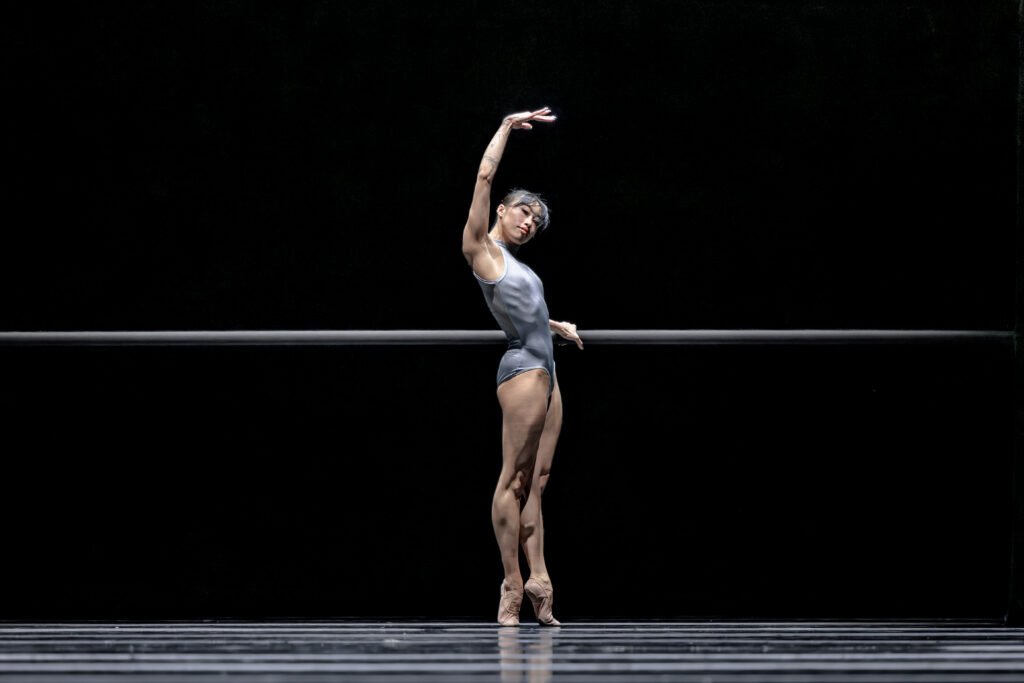
For those familiar with the San Francisco Ballet School across the street, the visual echo is unmistakable. Students train in pale blue leotards, hair secured tightly, aligned at the barre in disciplined rows. Seeing a related palette flood the Opera House stage creates a quiet continuity between classroom and company. Even the most forward-looking contemporary ballet still begins with daily class. It still begins with repetition.
The simplicity of the costuming does more than modernize the aesthetic. With no ornamentation to soften the outline, every muscle is visible. The cut of the leotards reveals the articulation of shoulders, the tightening of calves before takeoff, the exact mechanics of a lift. There is nowhere to hide. That exposure creates a level of intimacy that borders on uncomfortable, not because of it’s provocativeness, but because of it’s honesty. The dancers are not presented as porcelain figures arranged for admiration. They are human bodies working at their limits. In that stripped format, something personal emerges. By the end of the evening, you feel as though you understand each dancer more deeply, having seen them without theatrical armor.
That said, the first half of the evening is marbled by the presence of Soloist Isabella DeVivo.
She appears repeatedly, in solos, duets, trios, and ensemble work, and the choreography seems to settle into her body naturally. DeVivo is petite and powerfully grounded. Her attack is sharp without looking rushed. She moves at full speed while maintaining clarity through her torso and arms. There is warmth in her presence, a brightness that reads all the way to the balcony. It is easy to imagine her crossing into other forms, whether contemporary concert dance or musical theater, without losing authenticity.
Madeline Woo offers a complementary luminosity, but there is nothing secondary about her presence. Where DeVivo is compact and incisive, Woo expands through her phrasing, allowing lines to bloom fully before resolving, as if she is savoring the architecture of each movement before releasing it. There is a generosity in the way she dances, an ease that never slips into softness. Even at full speed, she remains open through the chest and articulate through the arms, finishing every phrase as if it matters.
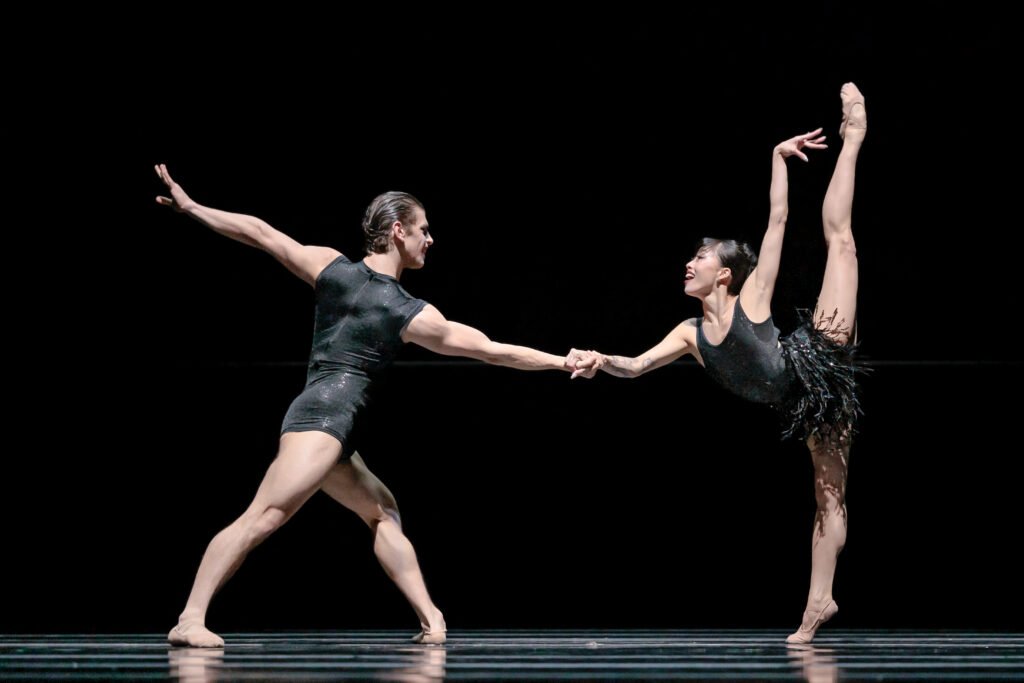
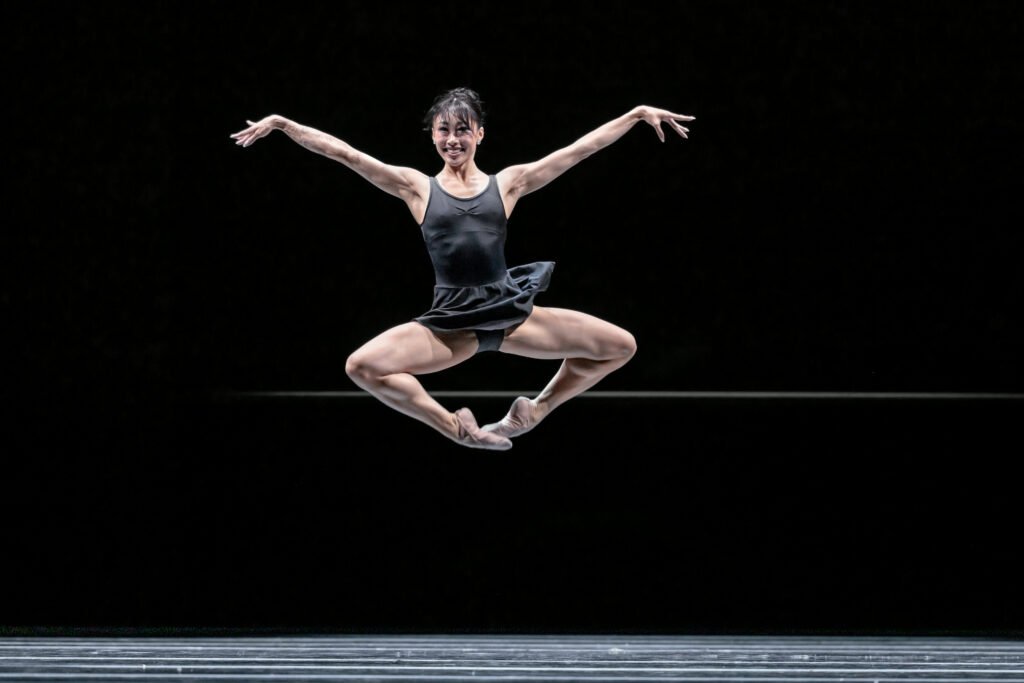
Together they anchor the early sections with a balance of strength and openness, but Woo’s energy carries a particular voltage. She does not simply execute Forsythe’s choreography; she amplifies it. By the time she reappeared in a sparkly black skirt, aligned with the swelling electronic pulse, the shift in the room was unmistakable. The audience knew it was time to party because Woo’s performance gave them the permission they needed to. She met the music head-on, radiant and unapologetic, and the entire house rose to her frequency.
As the musical landscape shifts, tension builds. Blake’s voice, initially hovering with minimal accompaniment, begins to accumulate rhythmic layers. The dancers sometimes move slightly ahead of the sound, creating an anticipatory friction that heightens the atmosphere.
Then comes The Barre Project.
A single ballet barre stands alone onstage, an unmistakable reference to the lockdown period when dancers trained at home, transforming furniture into makeshift studio equipment. Around that barre, the choreography becomes sharply percussive. Direction changes cut cleanly. Footwork accelerates. Madeline Woo, Isabella DeVivo, Harrison James, Cavan Conely, and others navigate combinations that demand precision at speed. The barre serves simultaneously as anchor and boundary.
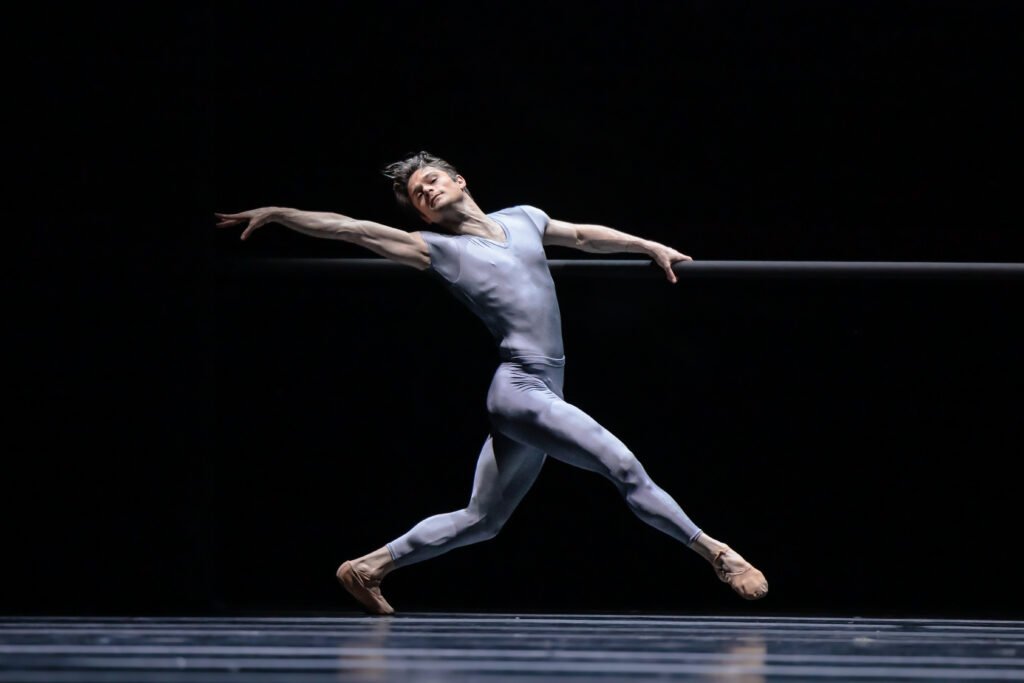
The audience responds almost physically. Heads nod. Shoulders relax. In a space known for decorum, restraint visibly gives way to engagement.
By the time Blake Works I unfolds in full, the electronic textures have expanded into something completely immersive for a usually passive audience. The War Memorial Opera House maintained the feeling of a new sort of temple for tradition, a night club-like shared environment shaped by rhythm and pulsating beats.
After intermission, Sasha De Sola, Nikisha Fogo, and Jasmine Jimison lead ensemble sections with striking clarity, the corps de ballet functioning as dynamic organism. Even in dense formations, individual presence emerges. Jihyun Choi and Jacey Gailliard project sculptural upper bodies and distinct carriage that reads clearly from the back of the house. However disciplined your gaze may be, it has a way of finding its way back to these two remarkable dancers, no matter the production, the formation, or the part they inhabit.
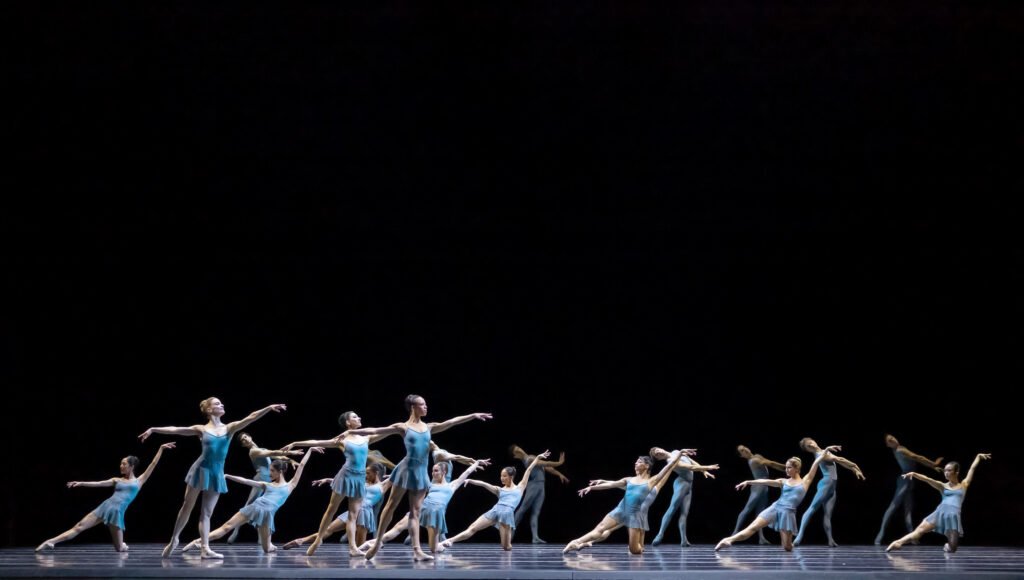
A trio featuring Isabella DeVivo, Esteban Hernández, and Jasmine Jimison brings kinetic electricity to the stage. Their chemistry is immediate, the speed of the choreography matched by their charismatic personalities toward the audience without excess. The effect is confident without tipping into display.
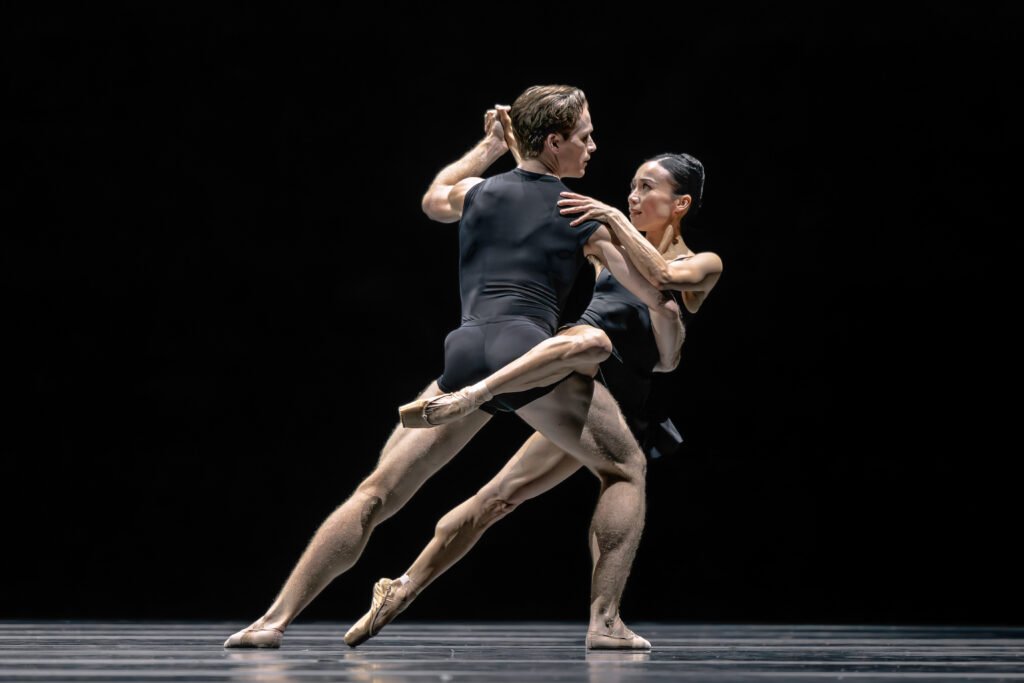
The emotional center of the evening arrives in the duet between Nikisha Fogo and Joseph Walsh. Their partnership avoids easy lyricism; what they bring to the stage is far from decorative romance and instead something that registers directly in the nervous system. They move like two people who know each other too well, pulling close and pushing away, circling back after creating distance as if neither separation nor contact can fully resolve what sits between them. At times she seems to melt into him only to twist free seconds later, as though staying would cost her something essential, while he reaches with urgency, hesitates, and then reaches again.
The choreography does not idealize love so much as reveal the exhaustion of it, the wanting threaded with pride, the vulnerability of returning when you swore you would not. You can feel the audience lean forward because what unfolds is not abstract but painfully human. I heard audible crying around me, and I heard a woman near me blowing her nose, not delicately but in the way you do when something hits too close. In a house this large, that kind of reaction does not happen unless people recognize themselves onstage.
An all-male ensemble section follows, and it lands differently. Yes, the athleticism is undeniable, but what stays with you is the tone. The electronic score gives the men space to move with personality, and what comes through is my favorite kind of masculinity: focused, intentional, strong without needing to prove it. There is swagger, but it feels earned. There is power, but it is controlled. No chest-beating, no caricature. Just men fully committed to the work, to one another, and to the precision of the choreography. It reads as confident rather than aggressive, grounded rather than showy, and that distinction matters.
Next, Sasha De Sola and Max Cauthorn arrive, and the room knows it. After the swagger and velocity of the all-male section, their entrance shifts the air, not by getting louder but by getting more precise. They step into the space with the kind of authority that doesn’t need to announce itself, and the ballet narrows its focus around them as if the entire evening has been moving toward this: a final pas de deux set to one of James Blake’s more expansive ballads, where the energy turns from percussive heat to something more sustained, more intimate, and more final.
Their partnering does not call attention to itself because it does not need to. De Sola steps into his hands without hesitation, and Cauthorn receives her weight as if it were a continuation of his own center, not a display of strength but an exchange of trust. The lifts do not spike upward for applause; they gather and rise, sustained long enough for you to see the control in her back and the steadiness in his shoulders. Transitions melt into one another with the assurance of dancers who are not proving anything, only inhabiting it. There is no excess, only an earned authority that lets the final moments unfold with quiet inevitability, offering the kind of closure one craves after the emotional whirlwind this particular ballet has carried you through. Together they end the evening with a quiet gravitas that explains, without spectacle, why they are regarded among the most revered principal dancers in the nation.
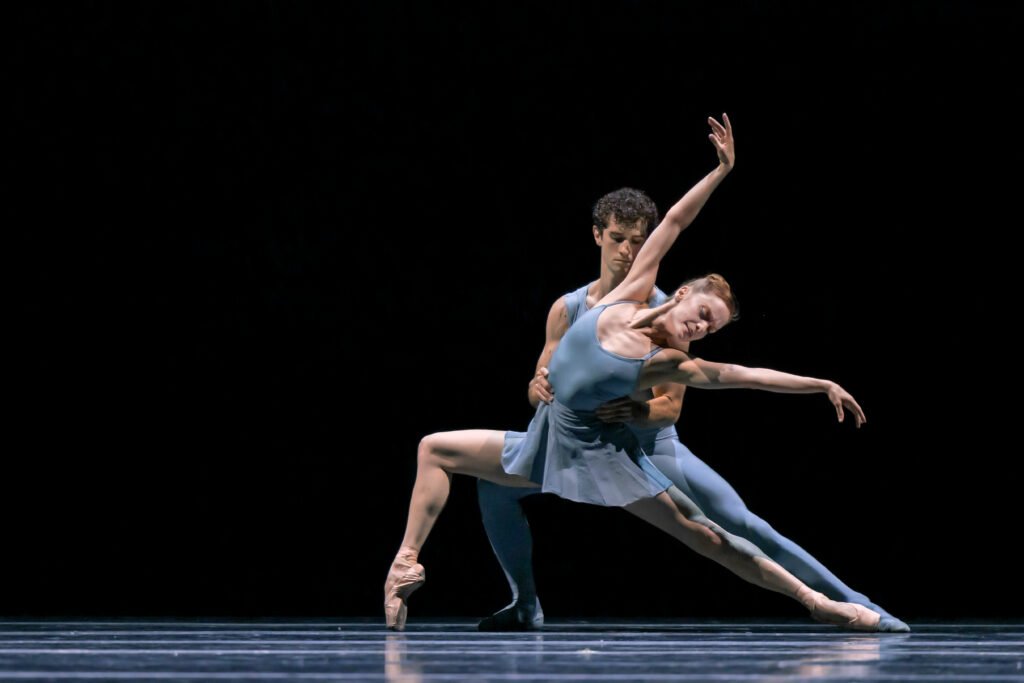
Throughout the program, Forsythe remains careful to reassert ballet’s classical grounding. Just as a phrase appears to drift fully into contemporary vocabulary, he inserts a declaration of lineage: a sustained arabesque, a rapid sequence of turns, a grand jeté that slices decisively across the stage. These moments do not feel full of nostalgia. They feel authoritative.
A ballet without an orchestra could have felt diminished.
Instead, it feels clarified.
The Blake Works demonstrates that San Francisco Ballet can honor classical technique while embracing electronic music and contemporary emotional narratives. It bridges rehearsal and performance, discipline and experimentation, past and future. If you love electronic music but have never considered yourself a ballet person, this production is your entry point. If you are a longtime ballet patron wondering where the art form is headed, this is a glimpse of the future.
It is lean. It is intelligent. And most importantly, it is alive, animated by electronic music that challenges classical form as much as it sharpens it, suggesting a future in which ballet and contemporary sound move forward together. In that intersection lies not only artistic evolution, but expanded possibility for dancers, musicians, designers, and crews alike, a broader landscape where collaboration replaces hierarchy and the art form grows in more directions than one.
Which is why, when you glance back at that darkened pit where the orchestra usually glows, it no longer feels like something is missing. The silence reads differently now. It feels deliberate. And you understand, almost without thinking about it, that something new has already moved in.
