

Who knew the Christmas Nativity scene could be so scandalous. Growing up, my little church in Olathe, Kansas always put on a live Nativity in the barn that came with the land the church sits on. Every winter, the middle school and high school youth groups dressed in costumes to represent the characters in the Nativity, and we were always able to bring in a few farm animals like donkeys and sheep. We would bundle up, take turns warming our hands inside the church, and sip hot chocolate between shifts. Our Nativity scene drew people from the community year after year. It was a unique and beautiful way of paying tribute to the reason for the season.
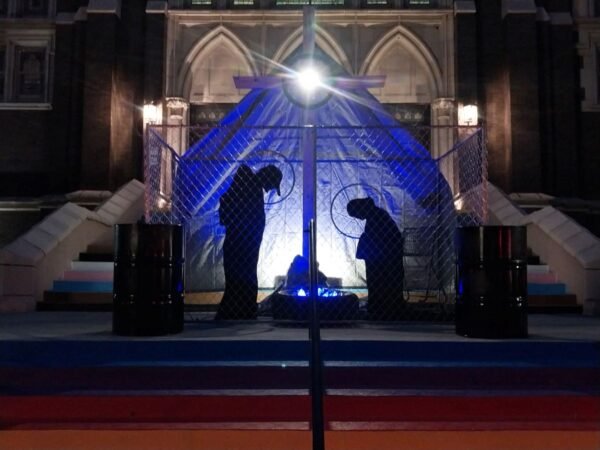
This year, some Nativity scenes looked very different. An outdoor display at the top of rainbow-painted stairs in Texas featured Mary and Joseph in a cage topped with barbed wire, depicting the couple inside an ICE detention center. On the outside of the cage were signs written in both English and Spanish that said, “Holy are trans lives,” “Holy is the refugee,” and “Holy are our unsheltered neighbors.” Inside the church was a model of Jesus’ birth with the characters missing and signs asking where Mary, Joseph, and the Christ Child were. There was also a sign that read, “ICE was here.”
This Nativity scene, created by Oak Lawn United Methodist Church in the Dallas area, is just one of many across the country using the parallels between the Nativity story and our current political context to comment on immigration, social justice, and modern-day suffering—something Christians, in my understanding, are supposed to do.
While the common Nativity scene makes the birth of Jesus seem peaceful, the historical context around his birth was anything but. Jesus was born in a manger—a literal donkey feeding trough—as his parents, Mary and Joseph, were forced to travel back to Bethlehem for the census. When Jesus was still very young and King Herod ruled the region, Herod heard that a prophecy had been fulfilled and that a new “king of the Jews” had been born.
Fearing a threat to his power, he ordered the killing of all male children in Bethlehem who were two years old and under—an event often called the Massacre of the Innocents. Because of this, the Holy Family fled their home and sought refuge in Egypt until Herod’s death. Only then did they return to Galilee. When put into context, the story behind the Nativity isn’t far from the tyranny we see in today’s world—a contemporary relevance that some churches refused to overlook this Christmas season.
Another noteworthy display in Evanston, Illinois, at Lake Street Church, depicted baby Jesus zip-tied in his manger and covered in a silver emergency blanket while Mary stood flanked by Roman soldiers in tactical gear labeled “ICE.” At another Illinois church near an ICE detention center, a sign read, “Due to ICE activity in our community, the Holy Family is in hiding.” In the Northeast, at St. Susanna Parish in Dedham, Massachusetts, the Christ Child went missing entirely, replaced by a hand-painted sign reading, “ICE was here.”
Some critics say these displays are sacrilegious and argue that churches putting out such stark depictions of the Holy Family should lose their tax-exempt status for speaking so divisively about political matters. A diocesan spokesperson spoke critically of the display at St. Susanna Parish, saying, “The people of God have the right to expect that when they come to church, they will encounter genuine opportunities for prayer and Catholic worship—not divisive political messaging.”
Still, Phil Mandeville, who sits on St. Susanna’s Parish Council and coordinates a multi-church refugee support committee, stood resolute in keeping the display despite the real risk of the archbishop closing the parish. “Look at the Gospel just before Christ was executed—That was political. We were always taught: When you’re unsure how to act, ask, ‘What would Christ do?’ Now we’re doing that, and it just doesn’t jive,” Mandeville says.
Leaders at other churches feel a sense of responsibility when it comes to using the religious art of the season to show how the Holy Family might be treated in today’s America. Rev. Rachel Griffin-Allison, senior pastor at Oak Lawn UMC, told United Methodist News, “We feel it’s important to depict the parallel of what’s happening in our world with what we understand to have been happening in the biblical story of the birth of Jesus. This is our opportunity to draw the parallel between the two.”
The rainbow steps in front of Oak Lawn United Methodist—the site of the first Nativity scene described—are themselves a symbol of protest. Back in October, when the state of Texas demanded that rainbow crosswalks be removed from the streets, Rev. Rachel Griffin-Allison said, “When forces of power try to erase symbols of queer joy and inclusion, the Church has a choice—to retreat into comfort or to step forward in courage. We’re choosing courage. The rainbow is a reminder that God keeps showing up—especially for those the world tries to silence.”
In a world that is so divisive, and being a Christian in a time when some of the most heinous behavior we’ve seen from government officials and their supporters is done under the banner of “Christian values,” I find these displays of protest—and education—refreshing. I used to fear being associated with the Christian Church because of the loud, disruptive voices that claim to speak for all of us, like the busking preachers in downtown Denver. Over time, though, I’ve realized that the Christians who are angry about these Nativity displays often don’t fully understand the message, or they find it easier to criticize the creative storytelling than to sit with the way the art challenges their conscience. It’s simpler to lash out than to engage in deeper, uncomfortable reflection—and unfortunately and understandably, that tendency gives the rest of us a negative reputation also..
I hope everyone, regardless of what you believe, had the best holiday you could have had—and if it wasn’t the best holiday, that’s okay too. Your experience is valid. Christmas, being a Christian holiday, along with all the family pressure or isolation that can come with it, is challenging for many people—and disproportionately so for the queer community.
