

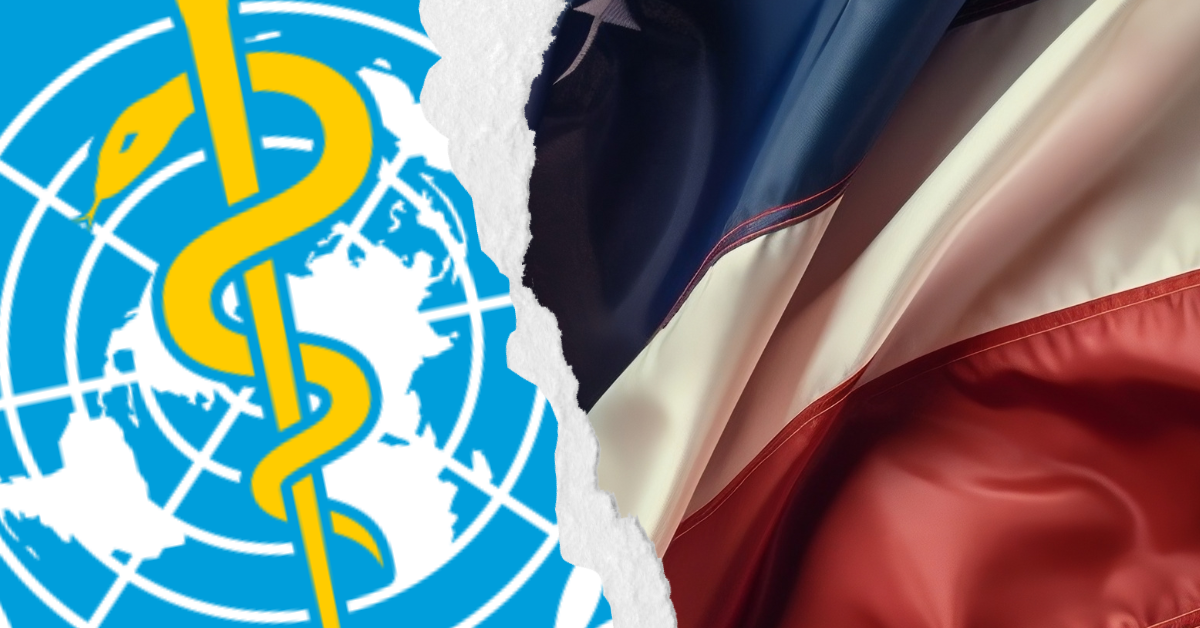
When the next infectious disease begins spreading across borders, the United States will no longer be part of the World Health Organization (WHO)—the world’s primary system for tracking outbreaks and coordinating global public health responses. As of Thursday, January 22, the United States has formally withdrawn from the WHO, a move scientists warn will make the U.S.—and the world—less safe.
For nearly 80 years, the United States helped shape global public health policy through the WHO. That influence, access, and coordination ended today—not because the WHO disappeared or lost relevance, but because the U.S. chose to walk away. The decision is political; the consequences are scientific, and the risks are shared.
One of President Donald Trump’s early actions in office was signing an executive order initiating the U.S. withdrawal. While the WHO constitution does not explicitly outline a withdrawal process, when the U.S. joined in 1948, Congress stipulated that the country could exit with one year’s notice and full payment of assessed dues.
Trump previously attempted to withdraw during his first term, but President Joe Biden reversed the effort. The process was revived after Trump returned to office, culminating in today’s formal departure.
In a joint statement, Secretary of Health and Human Services Robert F. Kennedy Jr. and Secretary of State Marco Rubio accused the WHO of “abandoning its core mission” and pursuing a “bureaucratic agenda driven by nations hostile to American interests.” The administration has argued the WHO mishandled COVID-19, acted too slowly, and failed to operate independently.
Critics note the irony of blaming an international health body while large segments of the U.S. public rejected masking, distancing, and other basic pandemic measures. The WHO was imperfect—but disengagement is not reform.
For decades, the United States has been the WHO’s largest or among its largest funders. Supporters of withdrawal argue the move will save money. Scientists counter that any financial savings are trivial compared to what the U.S. loses: early access to disease surveillance data, participation in outbreak warnings, and a seat in coordinated global responses.
Michael Osterholm, director of the Center for Infectious Disease Research and Policy at the University of Minnesota, calls early detection “a priceless gift.” He compares outbreaks to wildfires: a five-acre fire is manageable; a 5,000-acre inferno is a catastrophe. Without WHO data and coordination, the U.S. risks discovering outbreaks only once they’re already burning out of control.
The administration has also complained that the WHO refused to remove the American flag from its headquarters. Kennedy and Rubio claimed the organization is demanding compensation and refusing to acknowledge the withdrawal. The missing context: The U.S. still reportedly owes more than $200 million in dues, and WHO officials argue the exit is not fully settled until obligations are paid.
Dr. Judd Walson of the Johns Hopkins Bloomberg School of Public Health says the flag is deliberate. It signals the door is still open. Individual U.S. scientists may continue collaborating informally, but the absence of formal membership weakens coordination—especially for critical decisions like selecting annual influenza vaccine strains.
This withdrawal fits a broader pattern of retreat from multilateral institutions, even as the administration claims it will pursue alternative partnerships while maintaining global leadership in public health. That confidence is not widely shared by the people who actually study pandemics for a living.
When the next outbreak hits—and it will—the U.S. will find out whether isolation counts as independence or simply negligence. This wasn’t a budget cut or a bureaucratic reshuffle. It was a decision to step away from early detection, shared intelligence, and collective response in favor of ideology. You don’t fight wildfires by dismantling the smoke alarms. And you don’t protect public health by walking away from the world.
Ideology does not stop viruses–but early warning systems do.
Photo courtesy of social media
