

Back in June of this year, the Multidisciplinary Association for Psychedelic Studies (MAPS) met for its big Psychedelic Sciences 2025 Conference right here in Denver, Colorado. OUT FRONT Magazine was on hand to chat with people about our magazine and learn a little bit more about the organization and the ongoing field of psychedelics, especially as the laws around psychedelic-assisted therapy have loosened in Colorado and beyond. It was an eye-opening experience where we learned that the psychedelics industry and queer identities have a surprising number of intersections.
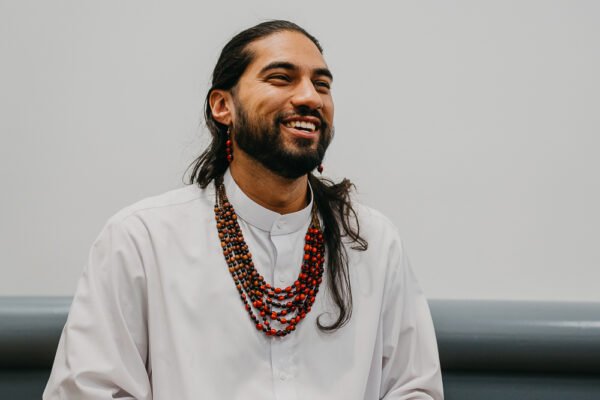
I had the pleasure of sitting down with Ismail Lourido Ali, JD, who has been involved in the leadership of MAPS for years and, at the time, had just been made interim co-director of the organization. We had a fascinating conversation about the expanding laws surrounding psychedelics, hope, and challenges for the future, and the intersection of drug policy with Muslim and queer identities in how they relate to state control. So, to close out our psychedelics month here at OFM, we present the entire fascination conversation in full (edited only slightly for clarity).
You’ve been interim co-director of MAPS for a few months now, and a big part of the organization before that, too. What is your vision for what MAPS can accomplish, either under your leadership or under the leadership of the new executive director once they’re identified?
MAPS has gone through a few different phases over the course of it’s now nearly 40-year life. I got to the organization about 10 years ago, and so I’ve gotten to see the transition from, you could say version 1.0 to 2.0 or 2.0 to 3.0 depending on who’s counting. The phrase I would use to describe 3.0 is “strategic convening.” In the early days of MAPS, it was the only organization that was doing all the things. I like to say it was like playing policy Whack-a-Mole because, something would come up, it would respond, something would come up, it would respond.
And before I was co-interim director, I served as the director of policy for five years. And I’m an attorney and brought in some of that legal strategy piece, but it was still reactive, like a lot of drug policy. And the idea is to be more proactive going forward. So strategic convening, in my mind, means not to do everything anymore because there’s dozens of organizations that have popped up. They’re filling niche aspects of the field or the needs of the ecosystem. And MAPS, instead of having to do all the things, can now support the connective tissue between those organizations so that they can speak a unified voice or move forward in, more or less, lockstep.
What do you see as the biggest challenges that we face in terms of drug policy and reform?
Probably two answers. One is maybe an unexpected one, which is that there has been, actually, a lot of hype in the last few years. And the mental health crisis is real. The isolation crisis is real. We’re all losing friends and family, and we’re all struggling through that. Every family, regardless of demographic or geographic location or whatever, is somewhat affected by this crisis of mental health and spirituality, however you want to frame it, depending on your own cosmology. And I think that because of that, there’s been a silver bullet effect. There’s these big social problems, so psychedelics can fill the gap.
And I always try to reinforce that, here at MAPS, we’re not like evangelicals, like everyone needs to do psychedelics, they’re good for everybody. But, in some ways, for a while, it was pushing the public past the stigma, and that’s really important. And now everyone’s really excited, and maybe too excited, and maybe there’s a certain level where we actually want to find the right carrying capacity. So to me, the hype machine has actually, I don’t want to say hurt the movement, but it’s definitely brought up new obstacles.
And I think the other is the consistent ways that people are educated about these practices. And, in some ways, that’s a good thing because there’s a diversity of frameworks. There’s indigenous traditional practice, Western treatments, or something in between. And I think, in some ways, that’s good because there’s a massive range of ideas and visions. But we look back at the war on drugs, and that definitely didn’t work, and nine out of 10 people will say that. But we look forward, and those 10 people have 10 different opinions. So, what I would like to see is a little bit more coalescing. And I think we’re now fractaling out. The next thing is how do we refocus to give us sustainable, pragmatic policies?
Speaking of that positive momentum, which perhaps can be a silver bullet, like you said, but we have seen some positive moves here in Colorado and in Oregon with the way psilocybin laws are changing and making it a lower priority criminally. Are there other places where you see hope for future advancements in drug policies like we’ve seen with those states?
Yeah. And did you mention New Mexico?
I didn’t know about New Mexico.
No one did. It was a pretty tight campaign. So, New Mexico, about a month and a half ago, passed the first major legislative regulated policy act. Oregon and Colorado went through the initiative process, New Mexico—and we’ve got some of the legislators here, and we spoke this morning—got a regulated access program through the state at the legislative level, which was a big deal because they did all these compromises and still ended up with something pretty cool. So that’s one thing, how New Mexico engages another left field.
One is Utah, which, unanimously out of the legislature, passed a bill, a state-regulated program, that utilizes some of the frameworks from the federal system. They put a flag, you could say, on an island over there, but they didn’t really create the bridge to get there. They legalized a behavior. They legalized activities without actually creating the legal way to get there. So, they started with that far-flag (idea), you could say, and now they’re going to be spending the next year, a couple years, figuring out how to actually make it possible legally. And those are both really exciting.
Alaska has a policy effort. I think they just submitted language for a ballot initiative very recently. It’s an indigenous-led group, which feels really significant because we’ve had indigenous inclusion in the conversation slowly, but it’s really bit by bit. But we haven’t really seen a fully indigenous-led state policy effort until this point in Alaska. So that’s super exciting. They’re also here.
And I think lastly, it’d be worth giving a shout-out to an effort that’s moving forward with the New Yorkers for Mental Health Alternatives, and it’s a permanent model. Most of the framework so far has been licensing models, where the cultivators or the distributors have licenses, and then a closed loop system within the state. But New York is taking an opposite direction, where they’re saying, ‘Well, let’s go to the individual, and let’s give them the permit space so they get educated, they get permits.”
I don’t really think any (path) is better or worse. I think they’re just different ways of engaging with the increased need and desire and hope to get more safe and responsible use accessible to more people. And we’re seeing a positive arms race, but not about the military, not about violence, but everyone’s trying to create the more accessible, the more available, affordable system. And they’re trying all these different things. So, seeing that expansion is exciting.
How does this conference fit into the overall mission of what MAPS is doing in trying to advance drug policy?
The immediate one that comes up is that it’s been a forcing function. You were asking earlier about the transition. MAPS is, I would say, the entire ecosystem is in this place. It’s in the liminal state right now. There was a lot of advancement; there was the hype; there (were) all these reputational and other obstacles that came up over the course of 2024, and we’ve been using this conference as a forcing function for the organization.
What do people really see as the priorities and the most important thing? We have our own idea and our own opinions, but also, how do we take in the opinions of the community? And one way that that was reflected is in the curation. So, two years ago, when we did this, we had one person chair each stage with 10 simultaneous stages. And they created the themes and the schedule, invited the speakers, looked at all that. Here we did the opposite. We had people submit their ideas, and then we zig-zagged and rearranged and figured out what it was. So that was one way that we were saying, OK, so we’re wanting to get more input from the community, how can (we) leave those things together and then put that back up?
So that’s one, and then the other is what’s happening right now. The more foundational thing I could say for this conference is math. We can do in one, two hours in person (what) we could do over 1000 zoom calls. And I do a lot of operational or logistical work from afar. But trust-building, I think, happens a lot in person. So much of this field’s about trust because we’re coming out of an underground, criminalized environment that’s all based on trust. Even from who you’re getting your things from, or who you’re listening to. So that feels like another big one, which is gathering people in person so they can build trust over mutual interest in education. That we’ve been doing since the beginning of this conference.
Just because we’re the LGBTQ+ magazine for Colorado. you’re very open about being queer, Muslim, and being involved in drug policy and legalization. Do you see an intersection with those aspects of your life, particularly in the way that they’re all subject to state control?
Yeah, I love this question. The state control thing is really important. I feel like we could have a two-hour-long philosophical conversation. So I’ll give my magazine answer, but I’m really glad you asked it.
I think so much of it has to do with the autonomy and how much agency we have as individuals relative to our own identity and the way that we show up both (in) what we do and who we are. So, one of the one of the first things I learned when I was working in this field 10 or 11 years ago is about this concept of sumptuary laws, which are the laws that determine what you can put in your body. And that’s everything from compliance stuff for food safety to drug safety to, I don’t know, rules that that tell you not to drink bleach. I found that area really interesting because sumptuary laws—and, let’s say, laws about how we identify ourselves and name ourselves—encroach upon individual sovereignty. And I have a little bit of a libertarian aspect of myself, which is like, well, people should have agency and sovereignty over how they show up and how they’re related to in the world.
And from a public health perspective, there’s certain things, let’s say, coming back to drugs, that it’s probably fair to have some sort of control. So, for example, even if we legalize drugs, I don’t think we should legalize drugs with no regulation. I think that when I go to the supermarket and buy food, there’s some standards that make sure that that food is safe. I think that, for example, quality control, great example of where the state could play a really significant role. In fact, I think scrappy nonprofits trying to do testing—which is important and we love them, and they’re doing it—but they’re doing it because of the neglect from the state. Now we have this weird situation where the state is over-involved, and the state is out here legislating how people call themselves and where they can go, which is over-encroachment in our engagement and not enough in keeping people safe and healthy. I think it’s less about should the state be closer or further (involved) and more about making it more precise and responsive to actually service the flourishing and well-being of people.
I’ll add one more layer on to with the because I was very Muslim, still identify that way, and so much of my first contact with state control is around surveillance and civil liberties. I feel like that was something that I started learning about and understood in the post-9/11 era. I was a young teenager figuring that out. And so that was the first thing. And then came drugs, and then came that gender expansion identity. So it was this interesting way where I had already had that foundation of, where should the state stay or not stay engaged?
Right now we’re in one of the most acute, highest-intensity moments where you have, again, this really—I don’t want to say imprecise, because it’s very intentional—but it’s very out of balance. I think engagement with the state is really out of balance, engagement where it’s over-legislating or over-controlling in some ways and under(-controlling in) others. (Whether) it’s drugs, whether it’s how we identify ourselves, whether it’s whatever, how can we make space for the way that we as individuals relate to ourselves and each other. Also, looking at the real crises, the real problems, whether it’s, again, isolation or other kinds of problematic substance use or other things and have the state actually helping all of its constituents in a more holistic way.
That’s all the questions I had. Is there anything else you wanted to talk about?
The overall psychedelic community and the queer community (have) been there from the very beginning, and there’s a lot of dark history with conversion therapy and things in the 50s. There’s a history of that. And I think that has to do with how queerness and how identity was understood at the time, and also the biases that existed in (the) medical system, (the) psychiatric system, mental health, and all that good stuff, or not good stuff.
And I think one of the really beautiful things that’s been happening the last few years—and this is one of those interesting things about the movement—is that, as the field has gotten safer to participate in. For many years, to engage with what it was as a researcher, advocate, or whatever, it came at great personal cost, sometimes professional, to be out about your psychedelic use or your engagement.
And I think, as the barrier to entry to participate gets lower, you have more and more people engaging with the issue, which is good for a movement to get bigger. And it means that people are coming in with a bunch of different motivations and incentives. That also means that people who are otherwise maybe incentivized—whether it’s because they’re queer, because they’re immigrants (or because of their) citizenship status—to be more quiet or to be less visible, because they’re worried about state encroaching on their rights because of politics. It’s actually allowed for more of a flourishing and that’s one of the interesting things. It’s safer to talk about so we have more people of color, more queer people talking about this than ever before.
Everyone always used to say people thought of psychedelics for a long time as a tech thing, or, like, a white thing, or this or that. It’s not true. Queer people, Black people, Brown people, Muslims, we’ve been doing psychedelics all for a long time. But people just weren’t talking about it. Because if you weren’t a straight white guy who had a tenure track job—and I mean that with no disrespect because there’s some awesome tenure track white guys—it wasn’t safe to talk about it.
So, what’s happening is, I think, the increasing safety or spaciousness that’s being created by visibility of the field is also allowing for way bigger diversity of experiences being brought forward. Every day here, there’s some gathering of different identities, even subcategories of the queer identity. And the fact that we can even get to that level of specificity, and that there’s enough people to create a critical mass of that, feels like a cool thing because it means that people feel safer to talk about it, more able to build community around it, and hopefully able to support each other’s communities.
Photo courtesy of MAPS
