

Returning to the opening night of the San Francisco Symphony Gala this year felt like stepping back into something both elegant and essential. I attended in 2022 and 2023, missed last year due to a business trip, and this time, the anticipation felt sharper. Part of it was my absence the year before, but the atmosphere itself felt more grounded and restrained.

The SF Symphony has a long-standing habit of staying unpredictable. During the regular season, they might stage a live film score performance or pair the orchestra with unexpected collaborators. At past galas, that same spirit has shown up in different ways. One year, Kev Choice, rapper, educator, and cultural fixture, shared the stage with the orchestra. They treat programming not as a schedule, but a glistening statement of intent. This year, they leaned more toward traditional classical selections. Still, it felt intentional rather than safe. The choices were focused and curated, not designed to please a broad audience but to reward those who listen closely.
The night felt elegant but edited. In previous years, the Gala followed a familiar rhythm: cocktail reception, concert, full-scale after-party. This year, it was simpler. A reception, then the concert, followed by a second reception with a cash bar. The shift was noticeable but understandable. Arts funding is increasingly fragile. Grants are disappearing, and donors are more cautious with both their wallets and their calendars. In that context, the fact that a gala happened at all felt like something to appreciate.

When I arrived, Drew Altizer Photography was stationed at the entrance, capturing the arrivals. I slipped through unnoticed, which is what happens when you’re everyone’s best-kept secret. Inside, the lobby was already full. The first and second floors were alive with conversation, the soft rustle of party chatter, champagne pouring, and plastic cups doing their best. Some guests arrived in black tie, others in street clothes. That contrast is very San Francisco. But to be clear, those dressed down were not the party crowd. They were the latecomers who skipped the reception and arrived just in time for the concert, most likely straight from work.
That is one of the city’s defining features. No one cares how you show up, as long as you show up.

There was plenty of time to ease into the evening. With the performance scheduled for 7 p.m., guests had a full hour and a half to mingle, sip, and take photos under flattering lighting. The atmosphere was relaxed and low-pressure. There was no sense of trying too hard. Even with the scaled-down format, the evening managed to feel refined, celebratory, and quietly confident.
The Performance: John Adams, Short Ride in a Fast Machine
The concert opened not with subtlety but with velocity. Short Ride in a Fast Machine by John Adams, performed by the SF Symphony, delivered exactly what its title promised. It came in under seven minutes and still managed to cover more ground than most film scores do in 90.

Adams, who held a residency with the Symphony from 1982 to 1985, composed the piece during that tenure. Decades later, it helped earn the orchestra a Grammy for Best Orchestral Performance under its in-house label, SFS Media. The award came in 2013, but the piece still feels connected to the present. It is impatient, relentless, and just overstimulated enough to feel familiar.
The music barrels forward, all pulse and pattern, as if composed by someone stuck at a red light in a Ferrari. It moves fast, turns sharply, and challenges the listener to keep up. The sound is layered and aggressive, but never chaotic. Every jolt feels deliberate. It is the kind of control that looks easy until you try to replicate it.
It also carries the anxious energy of the current moment. There is speed for the sake of speed, and motion without a clear destination.
The audience had barely settled in before the piece was already racing forward, as if it had somewhere more important to be. Whether or not that was the point, it landed. As an opener, it worked. It shook off the champagne haze, reoriented the room, and made it clear this would not be an evening of predictable programming. It was not warm. It was not slow. It was not interested in winning anyone over. It simply started, picked up speed, and vanished before anyone could catch their breath.

Yuja Wang, Tchaikovsky Piano Concerto No. 1
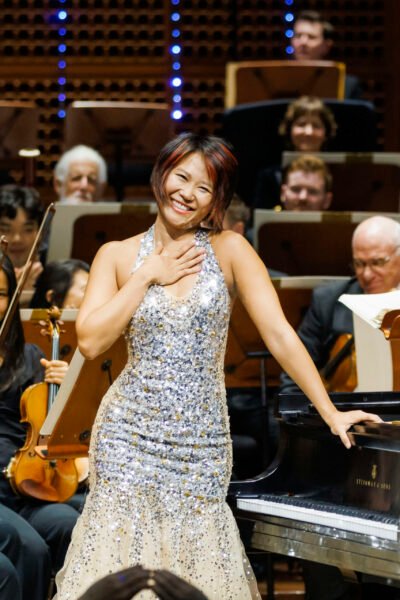
The centerpiece of the evening belonged to pianist Yuja Wang, who stepped onto the stage with freshly bobbed hair and a gold sequin gown that shimmered under the lights. She looked like someone who knew exactly what she came to do. The piece was Tchaikovsky’s Piano Concerto No. 1 in B-flat Minor, Opus 23. Known for its difficulty and sweeping emotional range, it demands more than precision; it demands presence. Wang gave it both.
Born in Beijing in 1987, she began piano at the age of six and trained across three countries. Her breakthrough came in 2007 when she filled in for Martha Argerich with the Boston Symphony. That kind of debut can overshadow a career. In Wang’s case, it launched one.
She performed the concerto entirely from memory, but it never felt like memory. It felt like embodiment. Her playing was focused, immersive, and exacting. She moved with the music rather than over it, almost as if the sound required her body to bring it fully to life. There was no ego in it. No excess. Just total commitment.

It is easy to forget that this piece was nearly lost. When Tchaikovsky first presented it to his mentor, Nikolai Rubinstein, it was dismissed almost entirely. Rubinstein reportedly told him it was worthless except for a few pages. Tchaikovsky refused to revise it. He walked away and found support elsewhere. The concerto was eventually performed by the Harvard Musical Association, before the Boston Symphony had even formed, and later debuted in St. Petersburg. It became one of the most enduring works in the classical repertoire.
That history carries its own resonance. It reminds us that bold, original work is not always welcomed, especially by those we admire. I have known what it feels like to be encouraged, only to be quietly sidelined once my presence came too close. In retrospect, rejection often says more about the other person than it does about you. They see something you don’t see yet. And that can feel like a threat.
This concerto holds that tension. It contains fury, tenderness, ambition, and restraint. Wang made it speak in full voice. She did not circle back. She advanced. Each musical idea shifted and morphed into something new, like thoughts unraveling in real time. The complexity of the piece was immense, but she moved through it as if instinct and intellect were in perfect balance. It never felt cautious. It never felt forced. She played with the kind of focus that makes everything around it go quiet. What she offered wasn’t a display. It was surrender.

She returned for bows again and again, her expression unchanged, as if the performance still had hold of her. The ovation rose in waves, not as praise but as release. The room had been holding its breath, for what we witnessed that evening felt more conjured than rehearsed.
Pines of Rome by Ottorino Respighi
The final piece of the evening was Pines of Rome by Ottorino Respighi, an Italian composer who came of age musically in Russia and later refined his voice in Berlin. It was a remarkable closer. Expansive, cinematic, and at times otherworldly. In both scale and texture, it mirrored the evening’s beginning, but in tone, it felt entirely different.
This wasn’t the sound of an action film. It was closer to the orchestral poetry of early Disney, the kind used to narrate light, shadow, seasons, and skies. Think Fantasia or Bambi. The kind of music that translates a sunrise or a forest into a tangible feeling.
Pines of Rome is structured in four movements, each representing a moment in the eternal city: children playing among the pines at Villa Borghese, the hushed mystery of catacombs, moonlight over the Janiculum Hill, and a Roman legion emerging through the mist at dawn. His compositions don’t just sit there and glow. They move. Weather rolls in. Light changes. Time passes. You can feel it all shifting beneath the music. It felt like a score for remembering—not what a place looked like, but how it lived inside you.

At one point, an actual phonograph recording of a nightingale filled the hall. It’s a required part of the piece. The recorded birdcall is paired with piano and flute, and the effect is arresting and doesn’t break the spell. It comes off remembered, like something echoing back from a dream.
The orchestration was enormous. Three flutes (with one doubling on piccolo), two oboes, English horn, clarinets, bass clarinet, bassoons, contrabassoon, four horns, three trumpets, three trombones, two tubas, timpani, triangle, cymbals, tambourine, ratchet, bells, harp, celesta, piano, organ, strings, and the nightingale recording. Add to that six offstage brass players (trumpets and trombones) who appeared near the end of the piece on the highest balconies of the hall. They were positioned at opposite ends of the room, at roughly 10 o’clock and two o’clock. Their fanfare was timed to echo the arrival of the Roman army at sunrise. It was theatrical but grounded. Not grandeur for its own sake, but with purpose you could feel.
What struck me most was how clearly the music painted its vision. You could hear the pines, the children, the hills, the sky shifting through color. At one point I caught myself holding my breath. It felt like being flown over a remembered world and allowed to linger there, not merely watching, but feeling it move through you.
Final Reflection
So what does a gala look like in a recession year?

Yes, it was scaled back. There was no blocked-off street party, no midnight band, no open bars stretching down Grove Street. Instead, we got a smaller reception, a performance, and then a quiet wind-down. But that simplicity brought something else into focus.
The music carried the weight. And it carried it well.
There was no fluff in this year’s program. No filler. Each piece felt handpicked for its richness, complexity, and emotional resonance. The musicians rose to meet that challenge. If anything, the evening felt more focused than in years past, more intent on reminding the audience why this institution exists at all.

What stood out most was the care given to every detail. The inclusion of rarely featured instruments. The spotlighting of sections that often stay in the background. The elevation of players who aren’t usually front and center. That choice felt meaningful, especially in a year where everything else was pared down.
Yuja Wang, of course, was unforgettable. There are pop stars with less charisma, less control, less command of the room. She doesn’t need pyrotechnics; she has tempo and touch and timing. Her kind of presence is rare in any genre.
So yes, this was a no-frills gala. But the performance was anything but bare. One of the unexpected highlights of the night was watching Jaap Van Zweden himself. The conductor was so animated, so physically invested in the music, that he often thrust himself onto the tips of his toes like a cartoon character winding up for takeoff. He wasn’t conducting the orchestra so much as channeling it, his body echoing every swell and crash in the music. It was impossible to look away. Honestly, it’s worth attending the Symphony on any night just to watch him work. The music soared. The hall held its breath. And I’ll keep coming back, not for the party, but for moments like that.
Featured image: Yuja Wang (Photo – Drew Altizer Photography)
