


Every year, we talk about reducing stigma, encouraging people to seek help, and normalizing conversations about mental health. But there’s a part of the conversation we rarely touch: what happens when someone does seek help—and the system gets it wrong, and that “help” becomes harm?
My story isn’t about refusing care. It’s about what happened when I asked for help and was met with inaccurate diagnoses, dismissive assumptions, and a system that treated my chart as more trustworthy than my voice. Mental Health Awareness Month and Pride Month should include stories like mine, because misdiagnosis isn’t just a clinical error. It’s a form of harm that shapes a person’s identity, treatment, and trajectory.
For years, I lived inside of diagnoses that never fit me. BPD. DID. Bipolar Disorder. Each one added with confidence, none of them grounded in who I actually was. These labels shaped how clinicians saw me, how they interpreted my reactions, and how they justified dismissing my voice.
I wasn’t treated as a person with a nervous system in distress. I was treated as a problem to be managed. And the consequences were traumatic.
The Labels that Stuck and the Person They Erased
Once a mental health label enters your chart, it becomes the lens that all of the providers that read your chart see you through. That lens can distort everything. At times I have regrets for reading the things written about me in my Epic MyChart records.
For years I have been called “non-compliant” and “wilful” to put things in clinical terms. I have also been called “manipulative” and told I “wasn’t trying hard enough.” I heard these words so many times that I couldn’t put my three shelves of workbooks and journals away until about 6 months ago. Keeping them visible was proof to myself that these harmful words written about me and said to me were not a fair assessment of who I was or how hard I was working on myself.
None of these words described me, or what was actually happening. I wasn’t refusing care; I was drowning in a system that didn’t understand me. I would reach out for help when I did not feel like I could cope with the stressors of life anymore, when the only option for relief was to not be alive and when I couldn’t stop thinking of ways to end my own life.
Isn’t asking for help what we are told to do when we start having thoughts to hurt ourselves and our normal coping tools and supports aren’t working?
I didn’t refuse to brainstorm solutions or access resources. My ability to come up with creative solutions and resourcefulness is why I succeeded at my case management job for as long as I did. When my nervous system is overwhelmed and I am in state of crisis, I do not have the capacity to take in new information or continue accessing resources alone. it wasn’t refusal; I had just reached my limit, and I needed some help.
This note was written about me in December 2023. None of the emergency departments in the area had seen me since before July of 2022 after several emergency department stays when I had been threatened to be strapped to the bed, berated by hospital security and nurses, dragged across the emergency room floor and forced to take out all of my piercings.
Most of 2023 was a pretty good year. I had gone from receiving the highest level of care at Wellpower down to the lowest level that still offered case management. This alone is testament of how hard I worked to improve my symptoms during that 18 months of not being in the Emergency Department in crisis. The above note in my chart still feels like proof that no matter how hard I work on managing my symptoms, no matter how much time passes, my past records will be what doctors see before actually hearing what I have to say.
Having gotten a recent AuDHD diagnosis, compounded by my complex PTSD that started in childhood and was exacerbated by the mental health system, I now understand that the “behavioral outbursts” were meltdowns caused by autistic overwhelm.
The threats and restraints didn’t regulate me. They traumatized me. And because trauma compounds trauma, my complex PTSD intensified. And if I am honest, I don’t know if I will ever feel safe asking for help in a mental health crisis again.
The system mistook the effects of its own harm as evidence that the original diagnoses were correct.
The Prognosis that Nearly Broke Me
In 2024, a doctor wrote in my chart that my prognosis was “fair to poor.” They questioned whether or not the mental health system would have the resources to help me. When I share this with people now, they gasp and say that was rude of the doctor to write. But honestly, it was one of the nicer things I have read in my records, at least it was honest, and for once it didn’t place all of the blame entirely on me for once. After almost one hundred psychiatric hospitalizations in the previous decade and my symptoms getting worse, this doctor’s statement made sense to me. 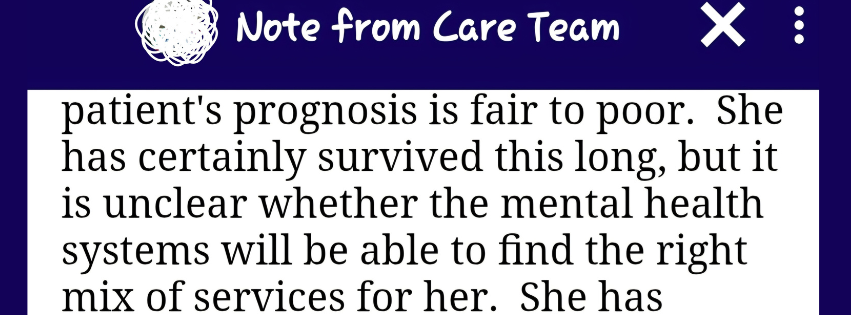
Around this time, I was also fighting with my outpatient medication provider over my ADHD medication that I needed in order to treat my ADHD symptoms. The executive dysfunction I experienced was making my depression and my anxiety symptoms worse. I was feeling completely hopeless and really doubting that life could ever look different for me when I could barely get out of bed most days.
When my medication prescriber made accessing medications outrageously difficult, I had to figure something out. I could not end up in the emergency department or inpatient again.
My Resiliency Finally Paid Off
I HATE when other people call me resilient, like it’s some sort of badge of honor I chose. I am resilient because my survival depended on it. Ironically, just months after the doctor wrote that my prognosis was fair to poor, I found the exact providers I needed—the support that the inpatient doctor who wrote that note doubted existed.
I refused to stay in a power struggle with a provider who held the prescription pad determining my access to medication that I knew I benefited from. I went to psychologytoday.com and sent an email to Denver Wellness Associates explaining my situation. The administrative team called me back and told me they had a wonderful provider who they thought would be the perfect fit, and her next available appointment was two days before my birthday. I booked the appointment without any hesitancy. Though I scheduled the appointment without hesitancy, I did have to read her profile on the website, more than a few times, because my trust of providers at this point was pretty microscopic.
When the date of my appointment finally came, I was so relieved by how well our conversation went. I opened up about some of the things I had been through the mental health system and why I had to leave my previous provider. Miriam completely understood. Hearing my experience, she had the perfect therapist in mind for me also, and she wasn’t wrong on that, either.
Approaching two years after my first appointment with Miriam and nearing my 100th appointment with Sarah (this is a big deal), life looks so much different.
I have been psychiatric inpatient free for over two years now. I have a better understanding of my symptoms, and the progress I have made is beyond anything I ever imagined possible for myself. I can’t give them all of the credit, I did the work, the work I had been accused of refusing to do, for years. All I really needed were mental health providers who saw me as a real person and not just a client whose insurance would pay them just for talking to me and sending in prescriptions to the pharmacy.
It was spending the time actually listening to my experiences that allowed them to pick apart the trauma, to see just how much my neurospicy traits impacted me, and ultimately leading me to get a formal autism evaluation.
An evaluation that would ultimately confirm an AuDHD diagnosis that makes everything else make so much sense.
My Late AuDHD Diagnosis: Now What?
Receiving an AuDHD diagnosis didn’t erase the PTSD. It didn’t magically undo the years of misdiagnosis. It didn’t rewrite the trauma of being restrained during meltdowns.
But it did something else, something life-altering:
It gave me a framework that finally made sense.
It explained why the BPD, DID, and Bipolar never fit.
It explained why I wasn’t “non-compliant;” I was unsupported.
It explained why my nervous system reacted the way it did.
It explained why I needed sensory-friendly approaches, not punishment.
And most importantly, it gave me language to protect myself and a diagnosis that will allow me access to resources that I didn’t have access to in the past.
The diagnosis is still new. I just read the 40-page report yesterday. Dr. Sarah from Mountain Vista Psychology, who did my evaluation, took the time to put together the report in a way that will help me understand my neurospicy brain and help me advocate for my needs in the future. While validating, learning that much of my trauma and mistreatment could have been avoided had I actually got the neuro-affirming treatment I really needed all along is also frustrating.
Naming the Harm is Part of Healing
If you’re reading this and something in your story feels familiar, here is what I want you to hear:
- You are allowed to question your diagnosis.
- You are allowed to ask for a second opinion, or third, or forth, or one hundredth.
- You are allowed to research symptoms (I encourage it; you know you best).
- You are allowed to advocate for sensory-friendly and trauma-informed care.
- You are allowed to say, “This doesn’t fit me.”
- You are allowed to advocate for yourself.
- You are allowed to hold providers accountable with the way they treat you is harmful.
You are not “non-compliant” for needing support that actually works for your brain. You are not “refusing to do the work” for asking clinicians to do theirs. You are not “willful” for surviving a system that misunderstood you.
You deserve care that sees you clearly.
Reclaiming My Narrative
I can’t undo the years of harm. I can’t erase the memories that live in my head forever now.
But I can tell my truth. I can reclaim my story from the system that miswrote it.
I can protect myself with the knowledge I have now.
And I can encourage others to trust their own lived experiences, even when the professionals don’t.
Mental Health Awareness Month Shouldn’t just be about encouraging people to seek help. It should also be about demanding that the help be accurate, compassionate, and safe. This is my contribution to that conversation.
This is the beginning of me naming the harm, so that others don’t have to live it.
Featured image designed by author
