

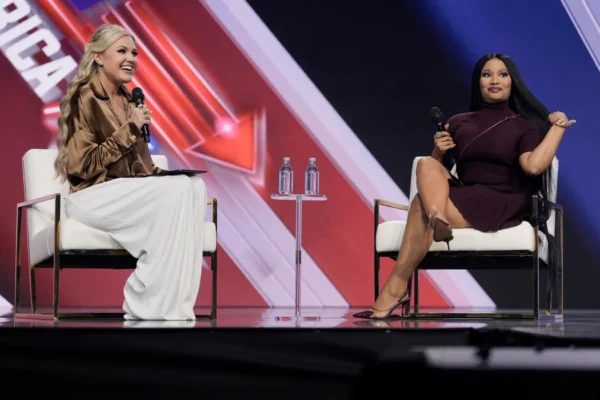
Nicki Minaj recently appeared at Turning Point USA’s AmericaFest in Phoenix, Arizona which fueled massive backlash from fans. Many expressed a sense of betrayal from a public icon they once saw as an ally, while others pointed to the deeper harm rhetoric like hers can inflict on marginalized communities, especially the LGBTQ+ community.
Her conversation with Erika Kirk—widow of Charlie Kirk and current CEO of TPUSA—had that uncanny quality where two people pretend they’re having a spontaneous heart‑to‑heart, but every line feels pre‑approved by the movement. Minaj gushed about how dashingly handsome President Trump is and praised both Trump and Vice President JD Vance as role models for young men, contrasting them with “Gavin Newscum,” the childish nickname Trump has used for California Governor Gavin Newsom.
Minaj then pivoted into the kind of “advice” that sounds more like scripted messaging than genuine guidance for young men. “Boys, be boys,” she said. “It’s OK; be boys. There’s nothing wrong with being a boy … Boys will be boys, and there’s nothing wrong with that.” The applause swelled as if she were delivering a motivational speech rather than reinforcing a familiar political talking point.
This kind of gender‑essentialist framing isn’t new, and queer communities have been warning about its consequences for years. OFM has reported extensively on how political movements weaponize rigid definitions of gender to justify anti‑trans legislation—most recently in coverage of Montana’s 2025 slate of anti‑trans bills, which leaned heavily on the same “natural masculinity” narratives echoed in Minaj’s remarks. Bringing that language onto a stage like AmericaFest doesn’t just mirror a political message; it amplifies a worldview that has already been used to justify real‑world harm.
Despite the over‑the‑top admiration for the current administration, this section of the conversation is what led to the biggest fracture among fans—or former fans—who once saw her as an ally. The sudden fawning over Trump stands in stark contrast to her earlier criticism during his first term, and the alarming shift in her values has left many feeling a whiplash‑inducing sense of betrayal.
During Trump’s first term, Minaj was unapologetically outspoken against the administration’s border policies that tore migrant children from their families. She shared her own story of coming to the U.S. from Trinidad and Tobago at age five as an undocumented immigrant. In a 2024 TikTok livestream, she went so far as to say she deserved “honorary citizenship many, many, many thousands of years ago” because of the taxes she’s paid—a statement that came off as both entitled and eerily reminiscent of rhetoric she now echoes.
Right‑leaning outlets like Fox News published headlines such as Nicki Minaj MAGA turn could spell serious trouble for the Democrats in midterms, with commentators comparing her to Trump and framing both as figures “exposing corruption.” For many observers, the irony is hard to ignore: two public figures praised for calling out wrongdoing while simultaneously defending individuals convicted of serious crimes.
Her AmericaFest performance also sparked a new petition on Change.org titled Deport Nicki Minaj back to Trinidad. Started by 16‑year‑old Tristan Hamilton on December 27, 2025, the petition surpassed 37,000 signatures by January 1, 2026. It asserts that Minaj’s statements “aren’t just insensitive; they undermine the very foundations of a community that looked up to her for advocacy and understanding.” Hamilton adds that deporting Minaj “would serve as a reminder that public figures need to be accountable for their words and the broader impact they have on diverse communities.”
This isn’t the first petition calling for her deportation. A July 2025 petition claimed Minaj was “spiraling out of control” following an incident involving Beyoncé and Shawn Carter. It raised concerns about her character and her defense of her husband, whose criminal history includes offenses that endangered others. That petition alleged she “poses a threat not only to the individuals she has targeted, but potentially to the broader community,” framing the issue as one of public safety and accountability.
One branding expert has argued that Minaj’s polarizing behavior won’t weaken her brand—It will amplify it by filtering out passive fans and deepening loyalty among those who admire strength over approval. But for fans who once saw her as a voice of advocacy, the sense of betrayal cuts deep. And speculation continues to swirl: some believe she’s cozying up to the administration to avoid potential deportation scrutiny, while others—including international outlets—suggest she may be hoping for presidential pardons for her husband and her brother, who is serving a 25‑to‑life sentence following a conviction for child rape.
So where does that leave us? Is Minaj grifting for personal gain, selling out her fan base, or undergoing a genuine ideological shift?
Photo courtesy of social media
