
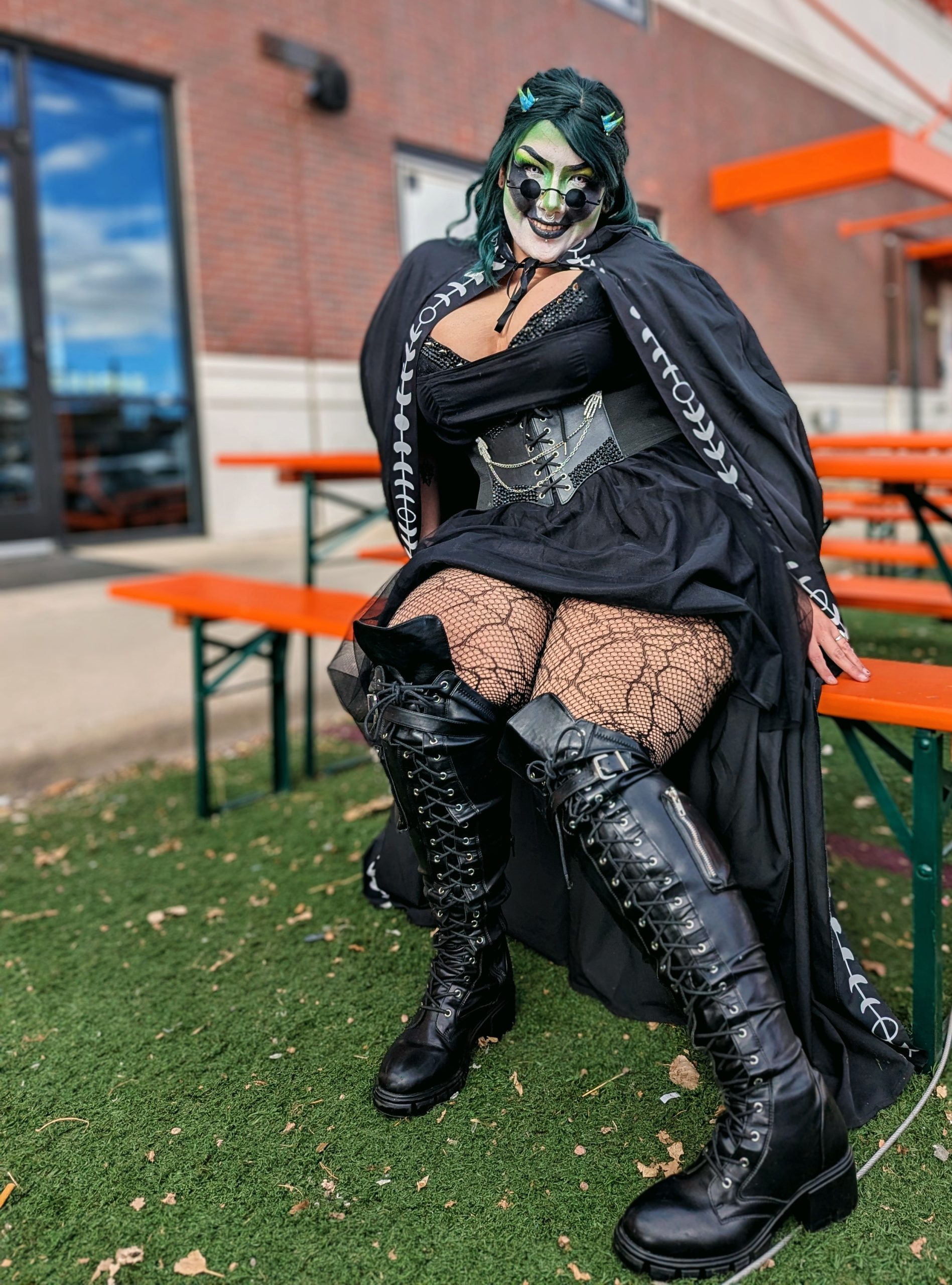
With Disability Pride Month coming to an end, we wanted to take the time to highlight one of our own! As our Entertainment Coordinator, you’ll most often him at OFM events. Transmasc performer Void Phlux (he/they) isn’t a drag king or queen; he’s a drag creature. Known for outrageously unique alt-drag performances, Phlux has also gained a reputation for making disability visible and sexy. But even when performing with a mobility aid, that doesn’t hold Plux back from putting on one hell of a show! They have C.A.D.A.S.I.L A, a degenerative brain disease. At just 15, he had his first stroke which progressed his disease at an earlier age than anyone at the time.
Who is Void Flux?
That’s a big one. I feel like Void is part of the parts in me that I want to empower. I got to put a lot of that into the Void Flux. On stage, I’m a little more of that confident and empowered feeling than just day-to-day Void.
How did you first get into drag?
it was right after things opened up from COVID. I was going to the goth night at Milk Bar every week, and I got to see performers in different wigs and outfits every week and how some of the performers where alternate drag performers. That was pretty much my introduction to alternative drag. A lot of the drag in Arkansas, where I’m from, was pageantry, and as you can imagine, I did not fit well into pageantry. Also Arkansas made you at the time be a bio queen, so they would announce you as a bio queen, and it was just really transphobic kind of way of like handling it.
But when we came back from COVID, I literally stopped every producer after their show and would just like be like, “I don’t know. what I’m doing yet, but, if you give me a chance, I can show you I can do something great.” And finally, I found a competition for newcomers, and that’s how I started drag.
How has your disability influenced your drag persona?
I would say that it’s a major part of my drag persona. I get to put the vulnerable parts of me that scare me from my day-to-day life about being ill into empowerment on stage. I want other people to see power in disabilities. You become better at 1000 different things because of this one thing you can’t do. I really wanted people to see that because when I first started I didn’t see a lot of like disability in the drag scene.
Now I feel people have become more accepting, more open to the idea. They try to get more accessibility. In the beginning, it was really hard because I felt like I was burning an uphill battle, just sliding back down because there wasn’t that much accessibility right after COVID. Producers really didn’t know how to make things accessible for me, so I would get skipped over if they didn’t think they could make it accessible for me. I took that upsetness and put it into my art, so lot of times I’ll, like, throw my cane.
In the beginning it was harder, and I think that’s what made me put more of my emotions about it into drag. That the frustratedness I feel with having to be attached to something like a cane or a rollator so I try to bring that to stage. I used to joke a lot that the stage was my free therapy sessions. Everybody else has to put up with me going through my emotions. The stage really helped with a lot of insecurity I had about disability stuff, and just putting myself out there more. Having to be in drag you always will be putting yourself out there, or people are not going remember your stage.
I’ve seen bars make alternative spaces for people that can’t go down the stairs. They’ll close off the bathrooms for them or something and that’s really nice, but I also by doing that, it cuts us away from the rest of the cast. It still kind of hurts your feelings, even if you do have an accessible space to not be in the main space. But there’s only so much they can be working on at a time. I’m really grateful that places do come up with these alternative spaces; I’ve seen a lot more like accessibility information in group chats where its being shared that there are two stairs up, and, like, a video of the stairs, so that we can prepare ourselves for when we get there to know where everything is.
That’s really important because even if someone doesn’t have a visible disability, it still is going to be like an issue for them. Having a layout of the space and the group chats is really accessible. People are more accepting now that I have pretty much a kitten attached to me. I have somebody that has to help me do get in and out of drag and stuff like that. People are starting to think things through, even if it’s just an awkward step. I’ve seen a ramp put over. It’s more in the consciousness of everything, and it’s not just, “We need to do these certain things for Void.” It’s, “We need to do these certain things for the disabled community,” because it’s not even just the disabled performers, but the disabled people that want to come see the show. That’s that’s just as important because if I’m out there doing disability drag, and there’s 100 able-bodied people out there, but the two people that are disabled can’t get into the venue, then I’m not doing what I feel like I should be doing.
How can we make these spaces more accessible?
It takes a lot of uncomfortable conversations with disabled people. It has been more comfortable for me when people are willing to sit down and have those conversations. Like, do we need to get a ramp? There’s going to be awkward conversations, and there’s going to be awkward fits. You tend to not realize somebody couldn’t do this thing because you’ve been able-bodied your whole life. It really takes talking to the disabled people and seeing what they need and how to get those needs met without making them feel any type of way or making them upset.
The biggest thing is just asking. I since I have degenerative brain disease, sometimes I get belittled when talked to, and some able-bodied people can also also think, “Well, I know what would be best for this situation, so I’ll just do it and avoid the awkward conversation.” You have to be willing to hear that and take it on and not be defensive about it. Just listening to the people in the disabled community, and also keeping disabled people in the front of your mind when you’re creating a show.
If we’re trying to boost marginalized people, make sure that disability is also included in that, like the ramps to get inside for access. There are going to be disabled people in every single crowd; you might not see them, and they might not need help up a step or their wheelchair pushed. But there’s disabled people in the crowd, and they notice. They’re going to notice when you put in effort and when you don’t. Being willing to have those awkward conversations and be like, “What do I need to change to best help you?” Because what best helps me isn’t going to help the next person as much. But I think just keeping that in the forefront of your mind is like there are going to be disabled people there. How can I better accommodate them? It’s better to ask than assume.
What does Disability Pride Month mean to you?
It definitely means something different for an able-bodied people than it does for disabled people. With the platform that I have its the only times that I get a moment to be like, “This is what I’m sick with; this and what’s going on.” It feels like an opportunity to get the word out there. I don’t have that feeling of talking to a wall.
Some people don’t know things about marriage laws with disability and stuff like that. I literally can’t get married or I will lose my disability benefits. Sometimes it’s overwhelming because you have all these resources popping up and trying to get your word out about your certain disability. We need to carry that energy throughout the rest of the year. Just like LGBT pride, we should be carrying that type of energy throughout the whole year. I do think that it’s great that it there is, like, a time for getting the word out. I wish there’s that kind of push the rest of the year and not just for the month.
Before I moved here, I didn’t really know about disability pride or anything like that. In Arkansas, or in the South in general, there’s not much medical advances. Even if there was a celebrated disability pride, it wasn’t big or anything. I didn’t even know the concept until I got up here and saw all the disabled performers posting.
Every year I try to make a post about my specific brain disease during Pride just to get the word out. It’s like getting to come out of the shadows. So much of myself was hidden behind disability stuff in Arkansas, and now disability pride feels like a moment in the spotlight. That probably sounds silly because I do drag all the time, but you get the moment where people are paying attention to my disability. It feels great to be celebrated for these things that I used to despise about myself.
I feel that during LGBT pride too. I grew up in the South, it was very hush hush about these things. To be seen and heard about those things, and not only that, but be celebrated. There’s kinds of disability pride shows and stuff like that, and I love getting to go and see all the new people, and just the connection you make during Pride is carried throughout the year. it’s a great. celebration.
What’s one message you have for those who are queer and part of the disability community.
It’s going to be hard, but keep going. Nothing about being a disabled performer comes easily to me. It was really hard in the beginning to learn how to pace myself and not just crashing every single week after a performance. I don’t want to give anybody the false advertisement that it’s going to be great all the time, and you’re just gonna have like a great time. But I would say it’s worth it. It’s gonna be hard, but it’s worth it. And I have so many friends that I’ve made from disabled performance. I’m in a happier place now. I think the hard was worth it.
Be sure to stop by Aurora Pride and check out all the hard work Void has done in organizing the performer lineup.
Photo courtesy of Void Phlux
