

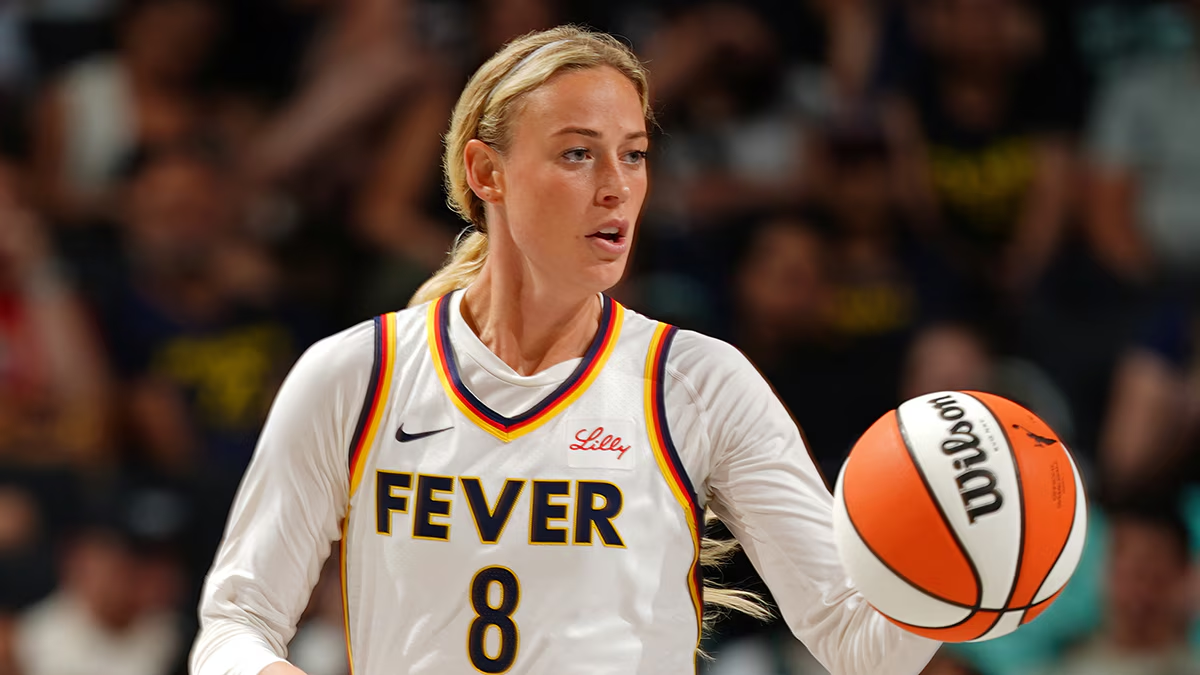
Indiana Fever guard Sophie Cunningham has spent the past month at the center of a growing controversy over transgender athletes in women’s sports. When reporters asked whether the attention was becoming a distraction, Cunningham had a simple response: look at the numbers.
“Look at my stats … I don’t know why people think this is such a big distraction … Great time to be a Fever,” Cunningham told reporters ahead of Indiana’s August 22 game against the New York Liberty. The Fever ultimately lost 109-102, with Cunningham scoring 10 points.
The comment followed weeks of backlash stemming from a July ESPN profile in which Cunningham said she wanted to “protect young girls” from competing against what she called “biological men,” language frequently used by opponents of transgender inclusion in sports.
So Them took Cunningham’s advice and looked at her stats.
According to the outlet, Cunningham averaged 9.85 points per game during the 13 games immediately before the July 21 profile. Over the following 13 games, that average dropped to 6.6 points—a decline of roughly 33%.
The numbers do not prove Cunningham’s comments caused her performance to decline, and other measurements paint a more complicated picture. Another analysis found that Cunningham continued shooting efficiently from three-point range during the stretch despite scoring fewer overall points.
Still, Cunningham’s remarks have drawn considerably more attention than her basketball statistics.
Since the ESPN interview, anti-trans demonstrations have followed several Fever games, with protesters using Cunningham’s comments as a rallying point in the broader campaign against transgender athletes. Cunningham has also appeared alongside anti-trans activist Riley Gaines.
The controversy has expanded beyond Cunningham. Former NBA players Enes Kanter Freedom and Royce White publicly declared their intentions to enter the WNBA draft in what was widely viewed as an attempt to mock the league’s transgender eligibility policies. Freedom was later removed from an August 23 Chicago Sky game after confronting players, including Natasha Cloud.
The debate is particularly notable because there are currently no transgender women playing in the WNBA. Former player Layshia Clarendon, who came out as transgender and nonbinary during their career, retired in 2024.
WNBA players have also pushed back against the growing anti-trans campaign.
Players including Stefanie Dolson, Gabby Williams and Cameron Brink have publicly supported transgender people or criticized the controversy surrounding their inclusion in women’s sports. Brink recently called the issue a manufactured distraction, pointing out the absence of transgender women from the league.
Cunningham, meanwhile, continues to insist the controversy has not affected her performance.
Whether her stats support that argument depends on which numbers you choose to look at.
Photo courtesy of social media
