

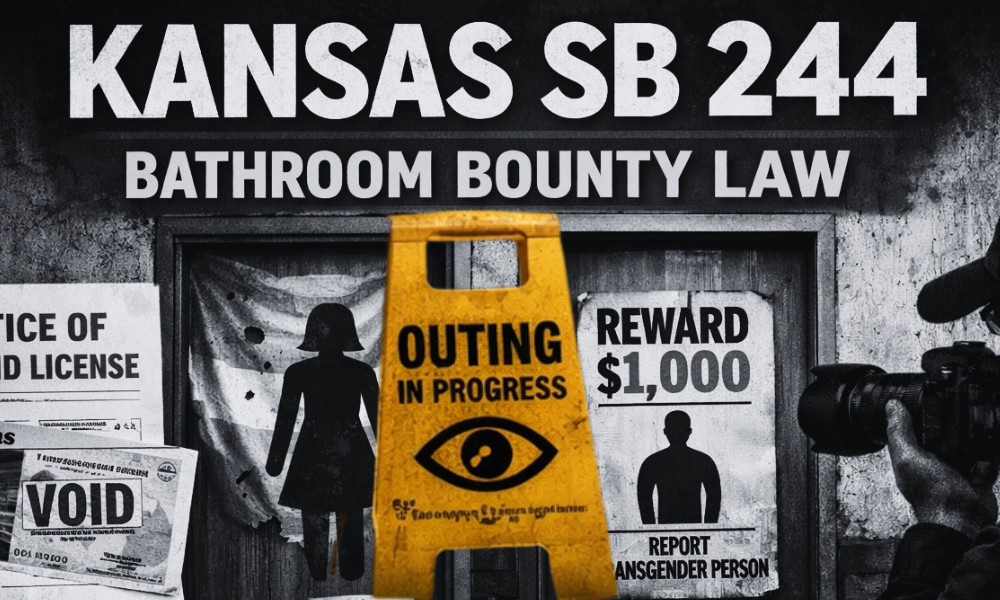
Kansas didn’t just pass a bathroom bill—Lawmakers have written bounty hunting into bathroom policy. SB 244 creates a system where private citizens can profit from outing, reporting, and suing transgender people for using facilities that match their gender identity. The bill was originally vetoed by Kansas Governor Laura Kelly on Friday, February 13. Republicans overrode the veto less than a week later, denying Kansas residents the opportunity to have their voices heard.
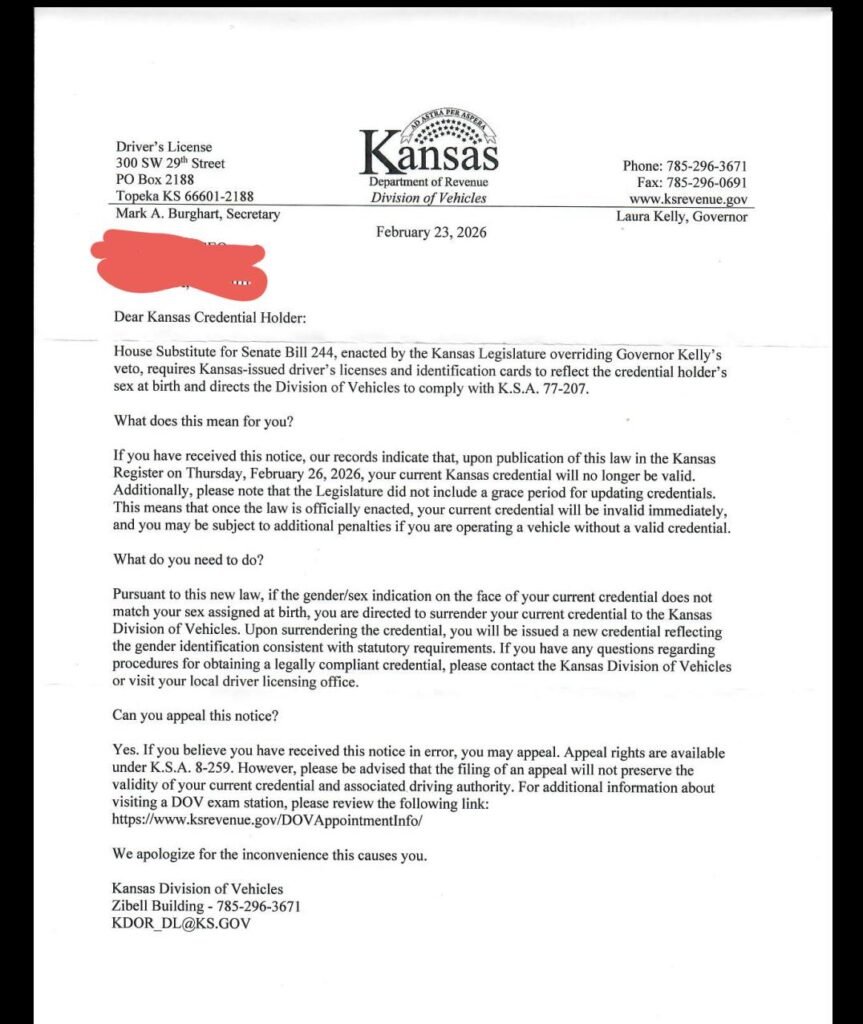
But the reach of SB 244 extends beyond bathrooms. In addition to incentivizing bounty hunting in bathrooms, the bill also invalidates the driver’s licenses of transgender individuals who had previously changed their sex marker to match their gender identity. This provision requires anyone who updated their sex marker to surrender their existing license and obtain a replacement reflecting their sex assigned at birth.
The way the bill was implemented only deepened its impact. Because the bill was both vague and rushed, most Kansans did not know when it would take effect. The confusion appeared intentional. The law stated it would go into effect “upon publication” in the Kansas Register—a phrase unfamiliar to most residents. This lack of clarity left residents caught off guard, agencies unprepared, and more than 1,000 transgender Kansans suddenly unable to legally drive.
The only form of notice to the public came in the form of letters dated February 23, 2026, sent to individuals who had updated their driver’s licenses to match their gender identity. The letters stated that their licenses would be invalid beginning February 26 with no grace period. Because the notices were sent by mail and only to those directly affected, many recipients did not receive them in time to comply before the law took effect.
This confusion did not just exist on paper—It played out in real time for Kansas residents. One Kansas resident who spoke to The Guardian said that when he went to get his ID updated on Thursday morning, the staff at the DMV didn’t seem well prepared. “He didn’t know what to do. And he kept asking me what the change actually was.” The man working behind the counter at the DMV had to speak with his supervisor for clarification, highlighting how unprepared agencies were to implement the new law.
For transgender Kansans, the consequences go far beyond inconvenience. Another resident, Anthony Alvarez, a student from the University of Kansas, spoke out about the increased fear this creates, saying it is “uniquely draconian and cruel to police trans Kansans using their neighbors.” Alvarez also explained that requiring transgender individuals to carry identification that does not reflect their gender identity means that anytime they present their ID, they are forced to out themselves. This forced outing is extremely harmful to transgender individuals’ safety and well-being.
Even lawmakers themselves warned about the human cost. State Representative Abi Boatman emphasized the inhumanity of the bill while addressing her colleagues: “I have sat here for five and a half hours, and listened to this entire room debate my humanity and my ability to participate in the most basic functions of society. And from the bottom of my heart, I hope none of you have to ever sit through something like that.”
In a later interview with the media, Boatman referred to the Republicans’ gut-and-go process as a “continued pursuit of the culture war” that harms the state, warning that “people that grow up in Kansas don’t want to stay here.”
Civil rights organizations are now preparing to challenge the law. Nonprofit organizations are speaking out and speaking up for Kansans, and the ACLU of Kansas is expected to challenge the new law in court. Human Rights Campaign President Kelly Robinson also issued the following statement:
“Instead of meeting the needs of their constituents, Kansas lawmakers have prioritized cruelty. As one of their first acts, they forced through this ‘bathroom bounty’ bill under the cover of night and then overrode the governor just days later, denying LGBTQ+ Kansans and their allies an opportunity to even speak in defense of their dignity. Forcing people into the wrong bathrooms, stripping them of accurate IDs, and allowing government-sanctioned harassment doesn’t make anyone safer—It targets transgender Kansans for no reason and will undoubtedly impact many others who are targeted with animus whether or not they are transgender. Meanwhile, leaders ignore real challenges facing families. This was sadly politics over people, but we will keep fighting for dignity and freedom for all LGBTQ+ people.”
These consequences are not abstract—They affect real people and communities, including places I once called home. As someone who grew up in the Kansas City metro area, I spent a decent portion of my life on both sides of the Kansas-Missouri state line. I am glad I am no longer living in the area, but I often fear for my queer friends and family members who still are. I also went to the University of Kansas in the mid-to-late 2010s. When I was there, I thought it was so cool that they added unisex bathrooms. I didn’t see this side of Kansas then. It makes the state feel unfamiliar to me now—It makes me want to go peel my KU bumper stickers off my car just to avoid being associated with the cruelty of the state legislature.
To my friends and family, and everyone else who is living in fear because of lawmakers who do not care about your human dignity, I am so sorry. What you are experiencing is not OK. You are not the problem. I have never felt unsafe around a transgender woman in the women’s bathroom. What makes me feel unsafe is knowing that laws like this tell people their identity can be erased, their dignity can be debated, and their existence can be treated as a threat. The Kansas I grew up loving was not perfect, but it was home. It is painful to watch it become a place where the people I love are no longer allowed to feel safe simply being themselves.
Graphic by the author
