

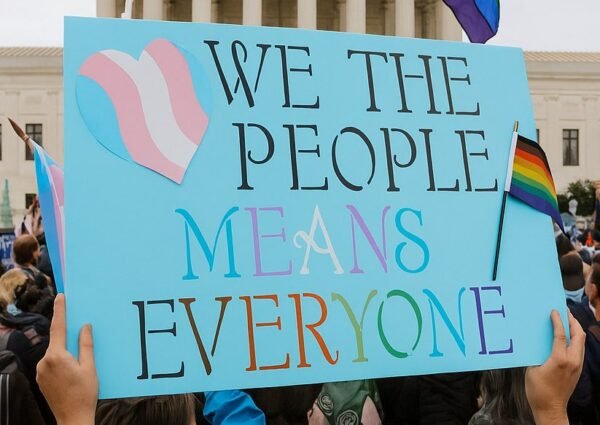
The Trump administration has officially declared gender dysphoria a national threat to society, labeling advocacy an act of domestic terrorism, taking the extraordinary step of implementing bounty rewards for organizations advocating for gender-diverse communities. For years, this administration has employed a pattern of labeling the trans community in ways that undermine their American-given worth even inspiring the acronym TIVE (Transgender Ideology-Inspired Violence and Extremism), coining terms like “gender ideology”—and, in more extreme rhetoric, “radical gender ideology.” These labels are more than just words; they are a political tool, a method of deflection from the administration’s own contradictions, inconsistencies, and statements that often have little relevance to the lived experiences of the people they affect.
The very organizations that keep people alive—crisis hotlines, youth shelters, health advocates, and community centers—are now forced to operate under the fear that compassion itself may be criminalized.
Pam Bondi, serving as U.S. Attorney General under Trump, spearheaded this initiative, placing a de facto bounty on organizations with vague rules and no clear directives on implementation. This ambiguity hangs over advocates’ heads like a cloud, forcing them to tread lightly in fear that even the most peaceful protests or community events could be met with heavy-handed responses—rubber bullets, tear gas, or legal intimidation—simply for exercising their right to organize.
When America is supposed to be the role model, taking steps to ensure life, liberty, and the pursuit of happiness for every citizen, how can we justify taking steps backwards? The path toward equality and justice is solid, but it only becomes more defined if we continue trodding through, despite obstacles, fear, and political hostility.
This move is emblematic of a broader pattern within the Trump administration: issuing directives and demands without follow-through, leaving citizens, organizations, and advocates to navigate the uncertainty themselves. It’s reminiscent of the childhood experience of asking a parent why a rule exists, only to hear the familiar refrain, “Because I said so.” But we are all adults now. To fully participate in the book club we call life, we need transparency, clarity, and shared understanding—not vague mandates that punish those who seek justice.
This is more than policy; it is a reflection of a worldview that seeks to silence vulnerable communities, obscure accountability, and sow fear. Yet, it also underscores the resilience of those who continue to advocate, organize, and live authentically despite the systemic obstacles. The path is challenging, but it becomes more defined the more we persist, demanding a nation that truly lives up to its promises.
In the face of vague threats, politically charged labels, and bounties that target advocacy itself, the resilience of the trans community and its allies becomes more than necessary—it becomes a moral imperative. Progress may be slowed, but it cannot be stopped. America’s promise of life, liberty, and the pursuit of happiness is not just a slogan; it is a standard we are called to uphold. The path may be obstructed, the rules unclear, and the opposition vocal, but if we continue trodding through with courage, clarity, and conviction, the road toward justice and equality will grow ever more defined.
