
For Randall Tarpey-Schwed and his husband, reading bedtime stories to their children was more than just a nightly routine. It was also a way to make sure their kids could see families like theirs reflected on the page.
“We read all kinds of children’s books to our kids,” Tarpey-Schwed, a San Francisco resident, tells KQED. “But I wanted to make sure that some of those showed their kind of family.”
Sometimes, his kids would even ask specifically for what they called a “Papa and Daddy book.”
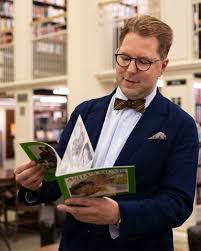
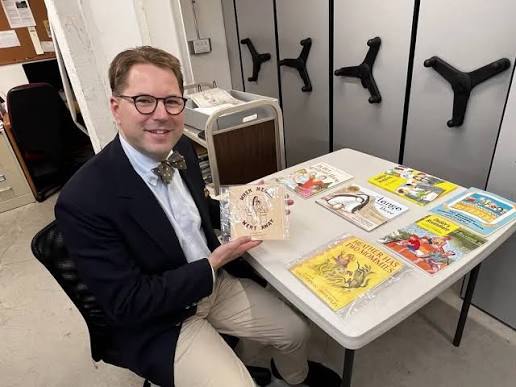
Those requests eventually inspired Tarpey-Schwed to start searching for as many children’s books featuring LGBTQ+ families as he could find. That effort has now become the Tarpey-Schwed LGBT Families Children’s Book Collection, housed at San Francisco’s Mechanics’ Institute.
The collection includes more than 200 books, magazines and other printed materials featuring LGBTQ+ characters, themes and diverse family structures. According to Myles Cooper, a librarian who helps manage the archive, it is one of the most extensive collections of early LGBTQ+ children’s literature in the country.
“This is a very fragile area of collections,” Cooper said. “They’re being banned, even in public libraries in California. It really is an area that we need to collect and keep and maintain just for our own history.”
The archive does more than preserve stories about queer families. Cooper said it also documents the history of publishers willing to take risks by printing books that included families outside the traditional mold.
That history feels especially relevant now as LGBTQ+ books continue to be targeted by organized censorship efforts across the country.
The American Library Association tracked 208 unique challenged titles in 2016. By 2025, that number had risen to 4,200, with nearly 40% of challenged titles featuring LGBTQ+ characters or people of color.
Much of the push to remove those books has been framed around “protecting children,” according to Sarah Lamdan, executive director of the ALA’s Office for Intellectual Freedom.
But Lamdan pointed to And Tango Makes Three as an example of how far those arguments can go.
The 2005 children’s book, based on the true story of two male penguins raising a chick together, has become one of the most frequently challenged books in the United States.
“How can you argue with that?” Cooper says. “It’s adorable, and it’s true.”
The Tarpey-Schwed collection stretches back decades, including titles such as I’ll Get There, It Better Be Worth the Tripfrom 1969, Megan Went Away from 1979, Heather Has Two Mommies, Daddy’s Roommate, 10,000 Dresses and Operation Marriage.
Many of the books in the collection have faced challenges or bans in school libraries.
Marcus Ewert, author of 10,000 Dresses, described the books as “little time capsules” preserving pieces of LGBTQ+ history.
For Tarpey-Schwed, one book in particular still carries special meaning.
Patricia Polacco’s In Our Mothers’ House follows a family with two moms whose neighborhood block party is interrupted by a hostile neighbor. After the confrontation, the other neighbors come forward one by one to show their support.
“And then—This is going to choke me up talking about it—What happens is that every one of the neighbors, one by one, comes up and gives the family a hug,” Tarpey-Schwed said.
For him, the message is simple.
“Even though it’s a complicated and nuanced story, at the end, it cuts right through to: ‘But your family is loved.’”
Photos courtesy of social media
