

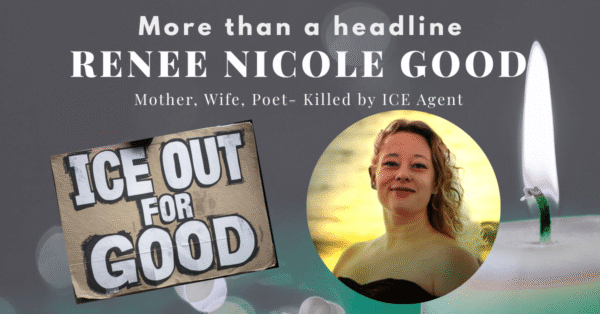
On Wednesday, an ICE agent—identified by Minnesota sources as Jonathan Ross—shot and killed Renee Nicole Macklin Good during a raid in a Minneapolis neighborhood. Her death occurred just blocks from where George Floyd was killed in 2020, a proximity that carries a weight Minnesotans cannot ignore. Floyd’s murder sparked the largest protest movement in modern U.S. history, with demonstrations erupting in more than 700 cities within days.
That history matters now. Americans have spent years protesting this administration’s policies, particularly the increasingly aggressive ICE operations unfolding across the country. Renee’s death is already stirring that same collective grief and resolve. Whether this becomes another national tipping point remains to be seen, but early signs suggest the country is bracing for a reckoning.
Before turning to the political fallout, it is essential to begin with the person at the center of this tragedy—the human being whose life was taken, and the family now forced to navigate a world without her.
More than a headline: The love, faith, and kindness that shaped the life of Renee Good
Renee and her wife, Becca Good, were living in Minneapolis with their 6‑year‑old son. He had just been dropped off at school that morning—a small mercy in a day that shattered their family. He will now grow up without either of his biological parents; Renee’s second husband, Timothy Ray Macklin Jr., died in 2023.
Renee was also the mother of two older children, ages 12 and 15, with her first husband, who has chosen to remain anonymous to protect their privacy. He described her simply: she was a devoted mother, and she was not a political activist.
On Friday, Becca released a heartbreaking statement expressing gratitude for the outpouring of support from across the country. She wrote that the “kindness of strangers is the most fitting tribute” because anyone who met Renee knew that “above all else, she was kind.” That kindness, she says, “radiated out of her.” She described her wife as someone who “sparkled.”
Becca also described Renee as a Christian who believed deeply in nurturing kindness—that “all religions teach the essential truth that we are here to love each other, care for each other, and keep each other safe and whole.” She refers to their 6‑year‑old as their son, and she intends to raise him in the way Renee would have wanted:
“I am now left to continue to raise our son and to continue teaching him, as Renee believed, that there are people building a better world for him. That the people who did this had fear and anger in their hearts; we need to show them a better way.”
Neighbors and family have echoed every word of Becca’s tribute. While I cannot include every beautiful thing written about Renee, I encourage readers to check out the comments on the GoFundMe page, which has surpassed $1.5 million and will be placed in a trust for the family.
Leaders Respond—and Tensions Rise—After Renee Good’s Death
By Friday evening, dozens of outlets had reported on the circumstances surrounding Renee’s death. Some of the most alarming statements came from the President and his administration, including Vice President J.D. Vance and Homeland Security Secretary Kristi Noem. The administration labeled Renee a “professional agitator” and described the incident as an act of “domestic terrorism” while defending the agent who fired the shots.
While I cannot legally assert that the agent whose bullets killed Renee is a domestic terrorist, his actions—and the administration’s framing—have left many communities feeling terrorized. Minnesota sources have identified the agent as Jonathan Ross, the same ICE officer who testified in court in December after being dragged by a vehicle during an incident last June. Noem has claimed Ross acted in self‑defense.
Yet the video released Friday from Ross’s own phone complicates that narrative. Immediately after firing into Renee’s vehicle, Ross can be heard saying, “fucking bitch.” Those words do not align with a claim of self‑defense and instead suggest anger rather than fear.
On January 7, Minnesota Governor Tim Walz held a press conference announcing that he had directed the National Guard to prepare for deployment while urging Minnesotans to protest safely. He said he shared the public’s anger and warned that ICE and DHS “want a show.”
A National Guard spokesperson later confirmed that the Guard was “conducting necessary preparations to assist state authorities in protecting property and ensuring public safety if so ordered,” though no formal request had yet been made.
Minneapolis Mayor Jacob Frey also disputed the federal government’s account after reviewing video footage. He states plainly that “this was an agent recklessly using power that resulted in somebody dying—getting killed.” He goes further, telling ICE to “get the fuck out” of Minneapolis.
On Thursday, Minnesota officials announced that DHS and the FBI were refusing to allow the state’s designated investigative agency to participate in the investigation. Walz responded that Minnesotans would have a difficult time accepting any investigation that excludes the state. Many Americans will feel the same.
At this stage, much of what the public knows comes from official statements and from videos circulating on social media. What is already clear is that any legal process ahead will be complex—but the public’s demand for accountability is not going away.
A Nation Rising for Renee Good: Her Legacy, Our Responsibility
As of midnight on Friday, protests had already taken place in dozens of cities, with a single advocacy group coordinating more than a thousand related events for the weekend. Throughout Saturday and Sunday, those demonstrations continued to build. What began in Minneapolis quickly spread across the country, with organizers reporting some of the largest crowds since 2020. The gatherings were overwhelmingly peaceful, grounded in grief, anger, and a shared refusal to accept the administration’s narrative. Many carried signs with Renee’s name, calling her death a line that cannot be crossed again. The message was unmistakable: Communities are done living in fear, and they are done being quiet.
Renee’s life touched people across multiple states long before her death, and now her story is reaching people who never knew her but recognize the pattern, the pain, and the urgency. What happens next will depend on the choices made by institutions whose decisions have already limited transparency and public trust. But what happens in the streets—in communities, in living rooms, in faith spaces, in the hearts of people who refuse to look away—will matter just as much. The demand for justice is not going to fade. It is growing, and it is rooted in something deeper than outrage: It is rooted in love for the people who should still be here.
So as demonstrations continue in the days ahead, I return to the words Becca shared with MPR—words that hold more moral clarity than any official statement released so far:
“We honor her memory by living her values: rejecting hate and choosing compassion, turning away from fear and pursuing peace, refusing division and knowing we must come together to build a world where we all come home safe to the people we love.”
That is the world Renee believed in. It is the world her family deserves. And it is the world so many are now demanding—not as a request, but as a necessity.
Graphic courtesy of OFM
