

Waking up in America now means bracing yourself for the latest unhinged, late-night social media tirade signed “DJT.” It’s no longer shocking—It’s routine. On Monday, February 2, Donald Trump once again proved that the most predictable thing about his presidency is his inability to let anything go, especially public criticism delivered with a laugh track.
After the 2026 Grammy Awards, Trump took to Truth Social in the dead of night to rage against host Trevor Noah, furious over jokes aimed at his character and his alleged ties to Jeffrey Epstein. Noah wasn’t the only one who spoke out that evening—but he was the one Trump singled out because satire still rattles men who rely on fear to govern.
What Trump seemed not to grasp—again—is that this year’s Grammys weren’t just an awards show, just like the Golden Globes wasn’t just a reward show this year either. The atmosphere inside the Crypto.com Arena felt less like celebrity pageantry and more like a civic reckoning. For the past year, critics have accused Hollywood of hiding behind glamour while the Department of Homeland Security inflicted real harm on real people. On Monday night, that silence cracked. Artists used their time, their clothing, and their applause to say what too many elected officials refuse to: The United States is failing its most basic moral tests.
Each time an artist condemned immigration enforcement abuses or wore “ICE OUT” or “Be Good” pins, the room erupted. That applause wasn’t performative—It was collective. And, tellingly, Trump ignored every one of those moments in his social media meltdown. The policies didn’t bother him. Human suffering didn’t bother him. The jokes did.
Trevor Noah did what comedians have always done: hold power up to the light and let it squirm. Early in the night, after a performance by Rosé and Bruno Mars, he joked that while “APT” was inspired by a Korean drinking game, Americans have a simpler rule: “Every time you turn on the news, you drink.” The laughter landed because it was painfully true.
Later, Noah reflected on how little—and how much—has changed since Lauryn Hill’s last Grammy performance in 1999. Back then, he joked, “The president had a sex scandal, people thought computers were about to destroy the world, and Diddy was arrested.” He also mocked Trump’s lawsuit against CBS by explaining the Grammys had to be completely live—because “if we edit anything, the president would sue CBS for $16 million.”
But it was Noah’s joke after Billie Eilish accepted Song of the Year that finally sent Trump spiraling. “Every artist wants a Grammy,” Noah says, “almost as much as Trump wants Greenland.” Then came the line Trump could not tolerate: “With Epstein gone”, Noah quipped, Trump “needs a new island to hang out with Bill Clinton.”
Cue the meltdown
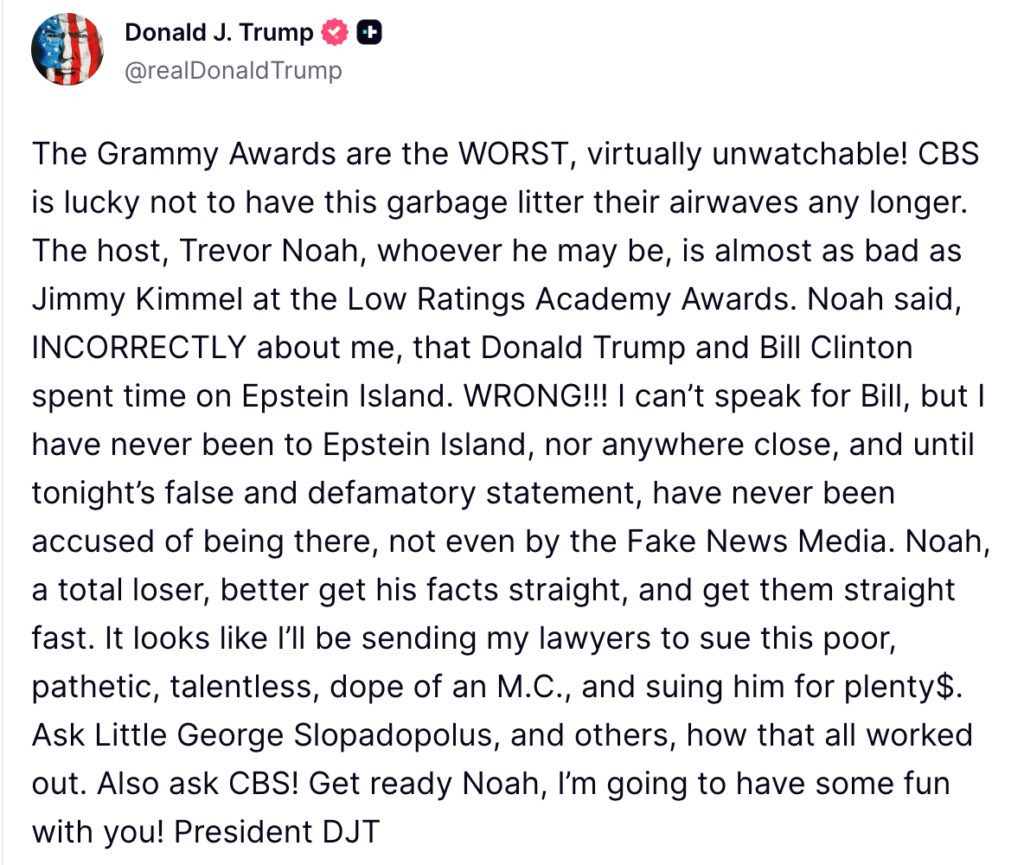
Trump declared the Grammys “the WORST,” accused Noah of defamation, and insisted—yet again—that he has never been associated with Epstein Island, claiming this was the first time such an accusation had ever been made. He followed up with the familiar cocktail of insults, legal threats, and self-pity, calling Noah a “poor, pathetic, talentless, dope of an MC” and promising retaliation.
This is not strength. It’s fragility with access to power.
What mattered most about the night wasn’t who got roasted—It was what got highlighted. The artists didn’t fixate on scandal. They focused on policy. On deportations. On detention. On the reality that DHS actions have torn families apart while the president had a meltdown over a joke.
I am tired of waking up to the consequences of a president who governs like an aggrieved influencer. I am tired of pretending this behavior is normal, harmless, or funny. A man who cannot handle a joke should not be trusted with unchecked authority.
