

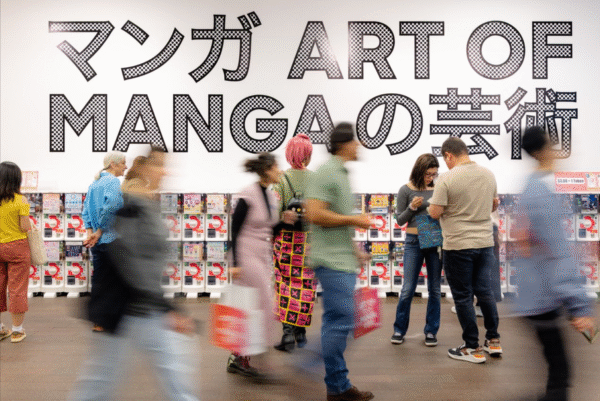
When you enter the de Young Museum for Art of Manga, you step into a foyer lit by rows of Gashapon machines, more than a hundred of them. These are the small capsule toy dispensers you find in train stations and arcades across Japan. At the museum they stand in a neat grid, each with its own series and its own digital tracking system that reports what needs refilling. The staff watches the data closely. It is a kind of caretaking that mirrors how they handle artwork. Before any artwork appears, the faint clatter of the machines tells you manga is part of daily life.

During our Zoom call, curator Nicole Coolidge Rousmaniere tells me she insisted the machines be part of the exhibition. They are not accessories, she says. They show how manga circulates in everyday life. “It is not just about the page,” she says. “It is about all the little ways people carry these stories with them.”
Art of Manga, open through January 25, 2026, is the first large scale exhibition in the Americas to present manga as an art form rather than a publishing category. It brings together more than six hundred original drawings and production materials from artists including Akatsuka Fujio, Chiba Tetsuya, Araki Hirohiko, Oda Eiichiro, Tagame Gengoroh, Takahashi Rumiko, Taniguchi Jiro, Yamashita Kazumi, Yamazaki Mari, and Yoshinaga Fumi. Many of the works have never left Japan.

Nicole introduces herself plainly. “I am a curator, and I am an academic, and I like to think I am a creative.” She is a professor at the University of East Anglia and the Research Director of the Sainsbury Institute. She spent fifteen years at the British Museum, mostly with Japanese arts. Her scholarly specialty is kogei, or craft traditions, but she has read manga her entire life. She talks about it the way some people talk about music they grew up with. It is part of how she sees.

Her first manga exhibition, at the British Museum in 2019, was a broad survey with fifty artists and one hundred seventy titles. It was aimed at audiences who had never encountered manga in a museum. “In London it had to be broad,” she says. “We had so many titles and so little room.” It was successful, but she left wanting more depth. “You could only give people a taste.”

The idea for a San Francisco show began when Thomas P. Campbell, director of the Fine Arts Museums of San Francisco, visited the London exhibition and asked if she would bring it west. The original show was not available to tour, and she did not want to recreate it anyway. “I never do the same thing twice,” she says. Work paused during the pandemic and then restarted from the beginning.
She thought about what manga might mean here. San Francisco has a long history of cultural exchange with Japan. It has strong queer communities. It has a creative tech culture. It has readers who are used to building identity and community through scenes and fandoms. Nicole wanted an exhibition that acknowledged that history.

Her intentions come into focus in one gallery that centers Tagame Gengoroh. “I wasn’t going to do this without Tagame,” she says. The room features pages from My Brother’s Husband, Tagame’s story of a Japanese man confronting his own discomfort and grief when his late twin brother’s widower visits from Canada. Nicole retells the arc slowly. Two brothers lose their parents young. One leaves Japan, finds a life, and marries. He dies. His husband arrives in Japan and meets the family who never accepted the relationship. The surviving brother struggles with guilt and fear. Mike, the widower, unsettles that life in small but profound ways.
“Nothing changes and everything changes,” Nicole says. What matters to her is how ordinary the story is. A drama about gay marriage aired nationally in fifteen minute segments on public television. She sees that as a sign of quiet but meaningful cultural movement.

We talk about why manga holds so many people, especially queer and trans readers. Nicole traces it to a history of publishing that draws in voices from the margins and lets them change the medium. She talks about early picture books, lending libraries, and artists who depicted what they saw rather than what they were supposed to see. She mentions Ito Yu, who writes about manga’s pattern of expanding outward rather than upward.

Then she explains kata, or form. Japanese society has recognizable roles. Professor. Salaryman. Housewife. You follow the form. Within the form there can be private freedom, she says, but the pressure to stay inside the boundaries can be intense. “If you do not fit into that box, it is very difficult.” This is especially true for queer people.

I tell Nicole that people in my life come to art forms like manga or anime from very different angles. My Black and trans friends often describe it as a place where they can imagine a world not governed by straight white male norms, a world that allows for other ways of being. My Asian friends tend to approach manga from the inside of the culture itself. They talk about drawing, production, collecting, and seeing themselves in the act of making. Nicole takes this in and answers in a way that links both experiences.
For her, manga rests on the line between structure and possibility. You can follow the expected shape of a story or step outside it entirely. You can draw blonde hair on a Japanese character. You can create a half machine, half human figure. You can write a domestic drama about two men cooking dinner. “You do not have to play the games,” she says.

That mixture of realism and freedom shows up again in Fumi Yoshinaga’s What Did You Eat Yesterday. Nicole calls it “such a good read” and laughs lightly when she says it. The laughter is small but revealing. Two men cook, talk, and move through the routines of a long relationship. On the wall, the pacing becomes more visible. You feel the pauses. The quiet beats between panels.

When I visited the exhibition on a Sunday, the galleries felt like a shared space rather than a hushed one. A teenager in cat ears posed for photos. Two older women compared notes on the One Piece pages. Someone’s capsule toy rolled across the floor. It was not rowdy, but it was awake.

The Gashapon machines matter more than they appear to. Nicole and the museum’s merchandising director, Stuart Hata, spent years negotiating with Bandai and other companies to bring them to San Francisco. Capsule toys are one way fans carry stories into daily life. The museum shop extends this idea with items drawn from manga rather than anime, including a T shirt Tagame designed for the show. Manga based merchandise is rare outside Japan. Nicole wanted people to have access to the original visual language.

She suggests visiting on weekdays for more breathing room. She mentions the fan pass created with Kinokuniya for people who plan to return. She knows manga rewards rereading. She also encourages visitors not to rush. “Pick one or two artists and spend time with them. Follow the images first,” she says. Manga is built for visual reading. Words settle in afterward.

What stays with me after talking to Nicole is how firmly she sees manga as both an art form and a record of everyday life. She talks about it as something shaped by ordinary people with ordinary concerns, even when the stories reach far beyond the real world. Manga can hold grief, joy, sport, queer domesticity, historical memory, and small jokes that run for pages. It can carry the weight of a family coming apart or the lightness of a character tripping over their own feet. It can give readers entirely new worlds to imagine themselves into, or it can sharpen their sense of the one they already live in. Part of its strength, Nicole suggests, is that it refuses to choose between those roles. It shifts as readers shift. It belongs in a museum because it has been doing cultural work all along, often invisibly, slowly shaping how millions of people see.

Art of Manga argues for this without raising its voice. The exhibition has confidence in the drawings themselves. It asks visitors to look closely, to slow down, to let the pages do what they were meant to do before they ever reached a wall. In the galleries you notice how a line curves, how a panel opens space, how an expression tightens or softens from one frame to the next. The show rewards patience rather than expertise. You do not need to know anything before you arrive. You need curiosity and time and the willingness to look. If you give the work that much, the stories will meet you. They have been waiting in plain sight.

All photos in this article courtesy of FAMSF/de Young Museum, San Francisco, CA.
