

“Oh blindness to the future! kindly giv’n,
That each may fill the circle mark’d by Heav’n:
Who sees with equal eye, as God of all,
A hero perish, or a sparrow fall,
Atoms or systems into ruin hurl’d,
And now a bubble burst, and now a world.“
This entire season at the San Francisco Ballet has been a kind of visual indulgence: big sets, heavy costuming, fully realized worlds that extend far beyond the stage itself, productions that build outward until you’re sitting fully inside it, and yes, at one point, a horse and a miniature horse on stage, which by then didn’t even feel surprising, it just fit.
Mere Mortals turns away from that instinct in a way that feels deliberate, like everything has been pulled back so you can actually see what remains.
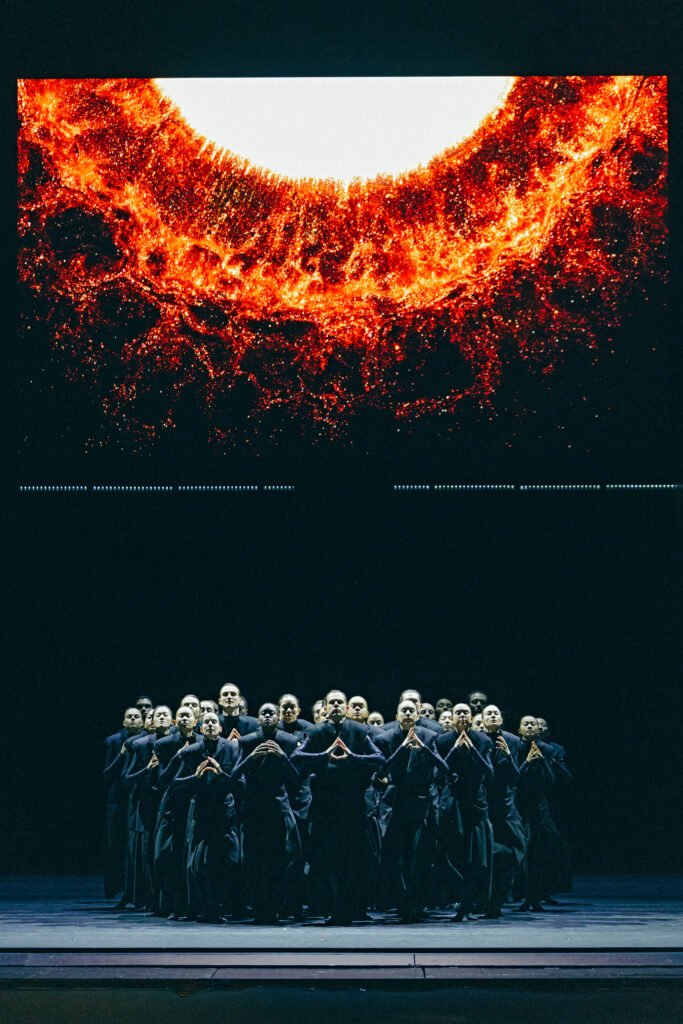
Instead of traditional sets, there are these massive LED panels that never settle into one place, they keep shifting, refracting, changing the environment without ever locking it down into one fixed set; so you’re not grounded in a location so much as you’re sitting inside something unstable. It keeps you slightly off balance.
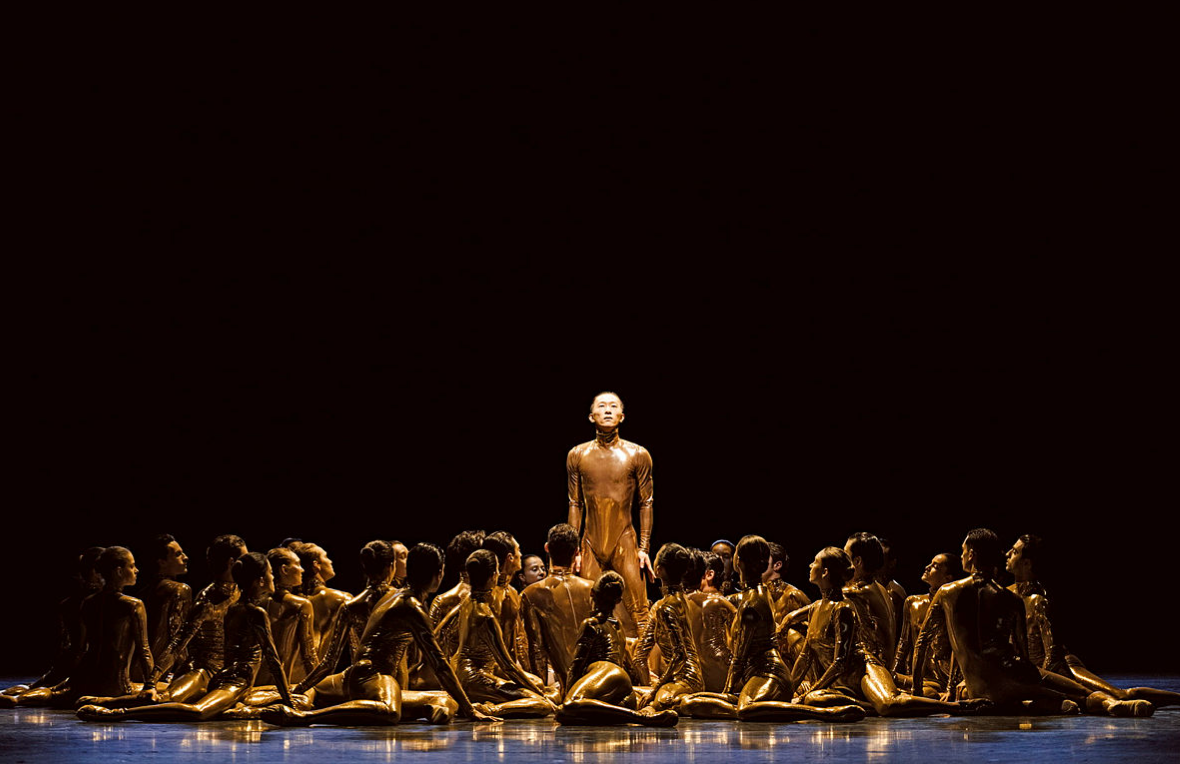
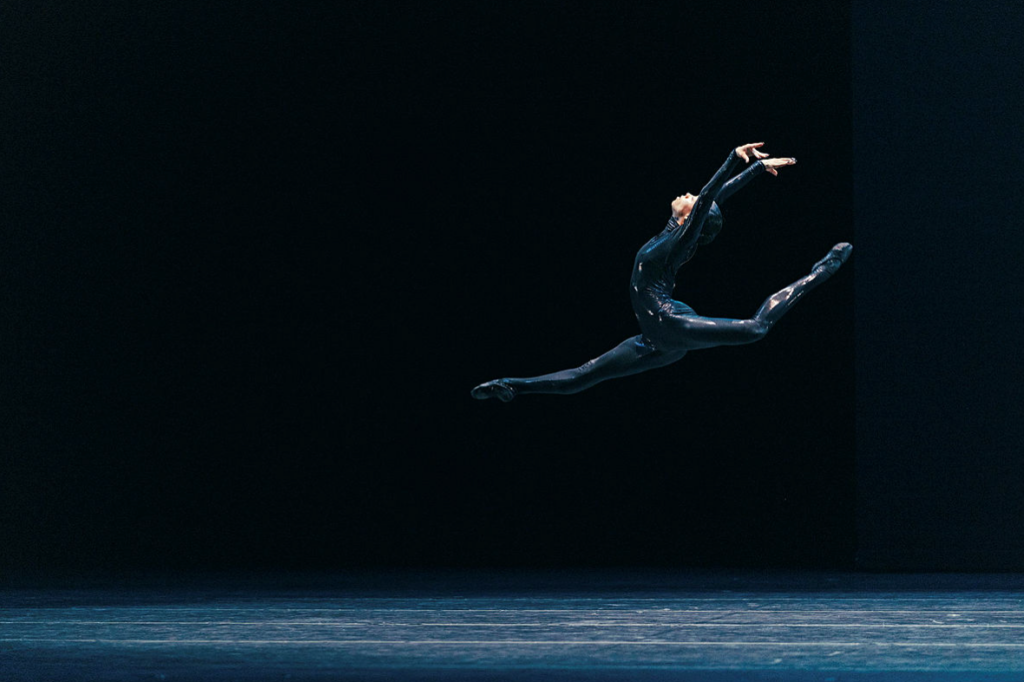
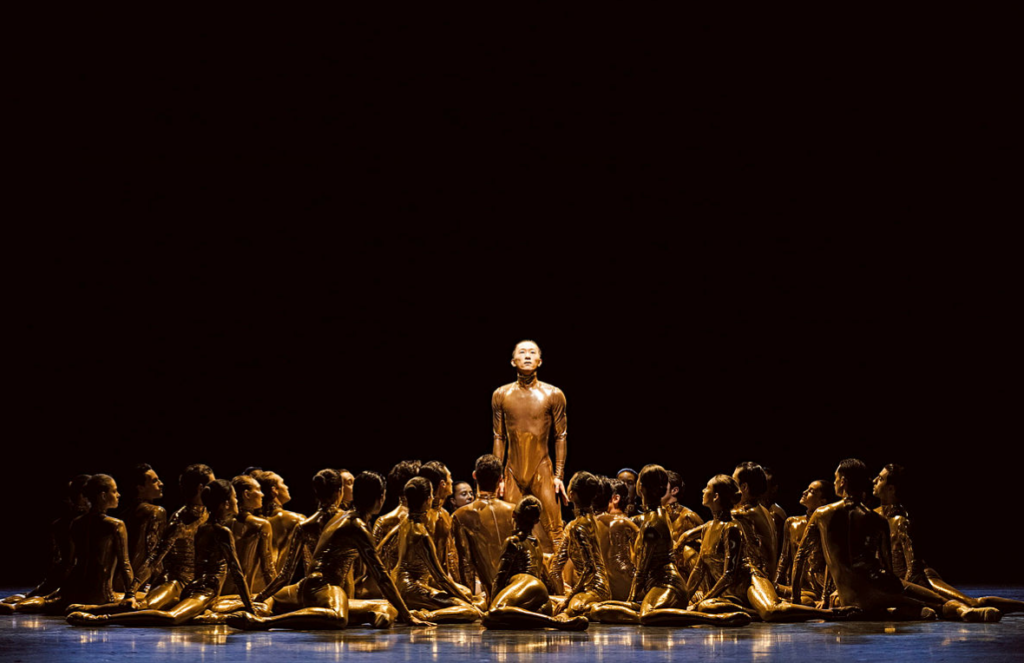
And then the costuming removes the rest. Everyone is dressed essentially the same, sleek, latex-like bodysuits, no ornament, no hierarchy, no visual cues telling you where to look, and no pointe shoes, everything flat, everything grounded, which immediately changes the physical language of what you’re watching.
So what’s left is just the body.
And once that clicks, the piece starts working differently, because there is nothing doing the work for them anymore. No costume finishing a line. No set building atmosphere. No hierarchy guiding your eye. It’s just presence, control, timing, and whether or not someone can actually hold space.
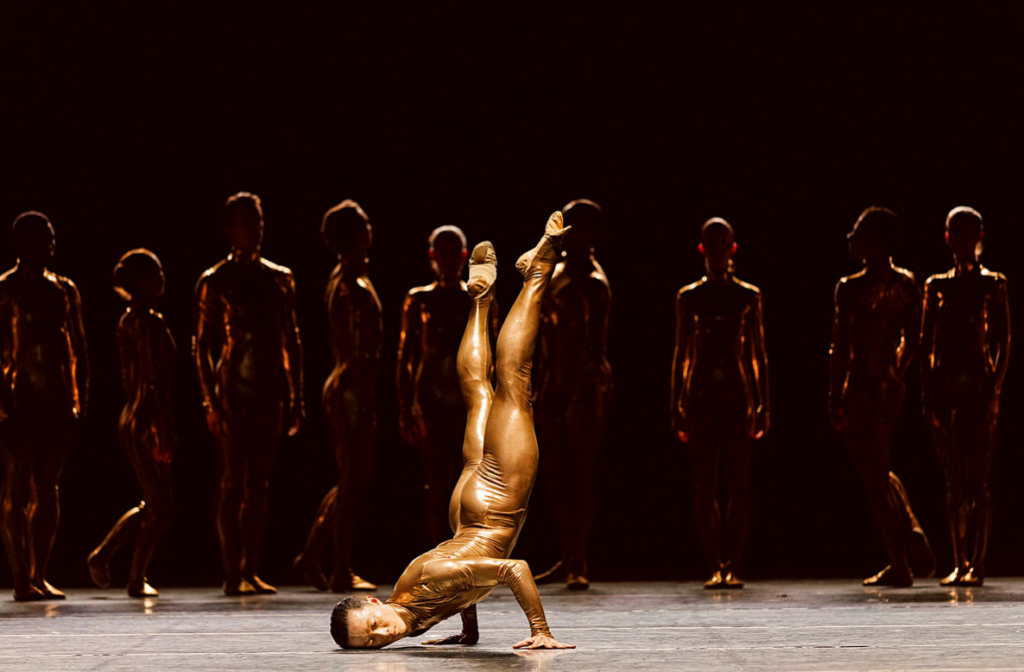
At first your eye resists that. You want structure. You want clarity. You want to know where to look. And then that falls away and something else takes over. You start noticing who commands attention without asking for it, who shifts the energy of a group just by being fully inside the movement, who feels complete versus who feels like they’re still searching. Essentially, when everything looks the same, the differences become obvious.
What was also interesting about this show, and something I kept coming back to, is that I always sit stage right, which means I’m right by the percussion section, and during Mere Mortals that became its own performance. I kept finding myself leaning over, trying to catch a better look at Principal Timpanist and percussionist (season substitution) Simon Gomez, because he was working nonstop. Floating Points does not let up on them. It’s constant, layered, physical, and you can see the effort in real time.
And it’s funny, because with everything happening onstage, you would think your attention would stay there, but it doesn’t. Not completely. Your eye keeps dropping into the pit, because the musicians are just as locked in, just as active, just as essential to what you’re watching.
Floating Points, aka Sam Shepherd, who wears being a PhD in neuroscience astride a being world class EDM composer, is building something with the score of Mere Mortals that the dancers and the orchestra are both inside of at the same time. Between the electronic elements, the 1960’s-era Buchla synthesizer, the solo violin from Cordula Merks, the harp of Annabelle Taubl, and then the full orchestra coming in, it starts to feel like everything is happening at once, but in a way that still holds together. It’s a lot, but it’s supposed to be.
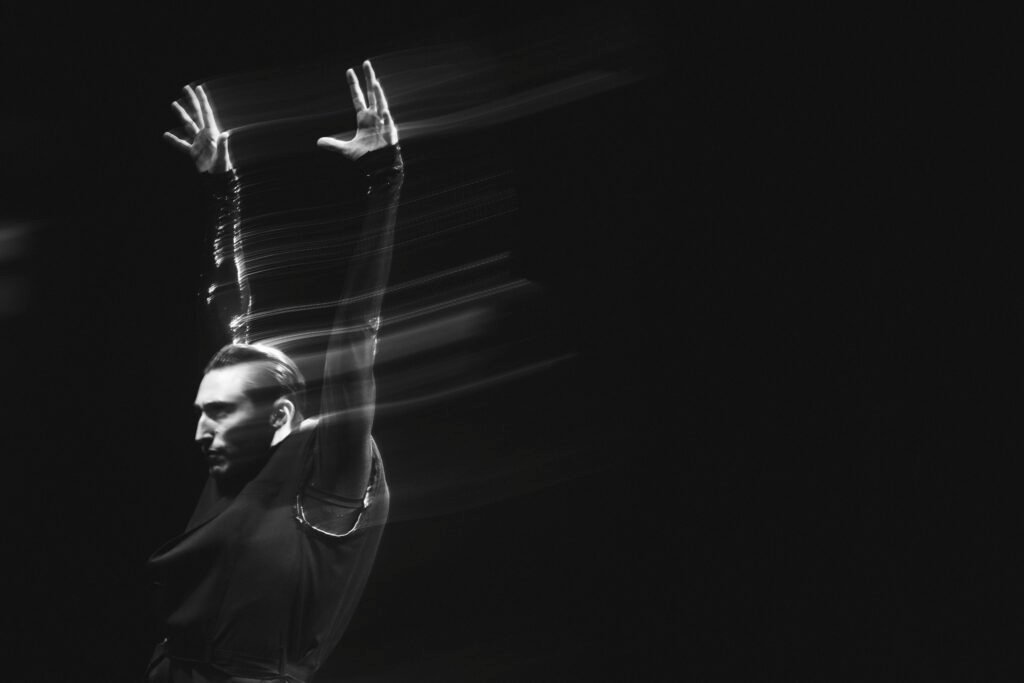
And you can feel that the musicians are in it, not sitting back, not just supporting, but actively navigating it. There’s a kind of alertness to the playing, like they’re responding moment to moment instead of following something fixed; similar to the way a film score or amusement park experience surrounds you, becoming encompassing all at once.
Also, and I mean this, the triangle player has been working overtime this season. Between this and Don Quixote, it’s impossible not to notice, which sounds like a throwaway comment but isn’t, because it says something about how present the orchestra has been across productions. And that’s part of what makes this feel complete. It’s not just the dancers carrying the weight of the piece alone, it’s the entire room working together as one living, breathing organism.
The Prometheus and Pandora framework sits underneath all of this without being forced, but it’s there, the idea of creation and consequence, of curiosity, of opening something without fully understanding what comes with it, and it’s hard not to think about where we are right now, with technology, with artificial intelligence, with how quickly things are being built compared to how slowly they’re being understood. The piece doesn’t resolve that concept, it merely holds it.
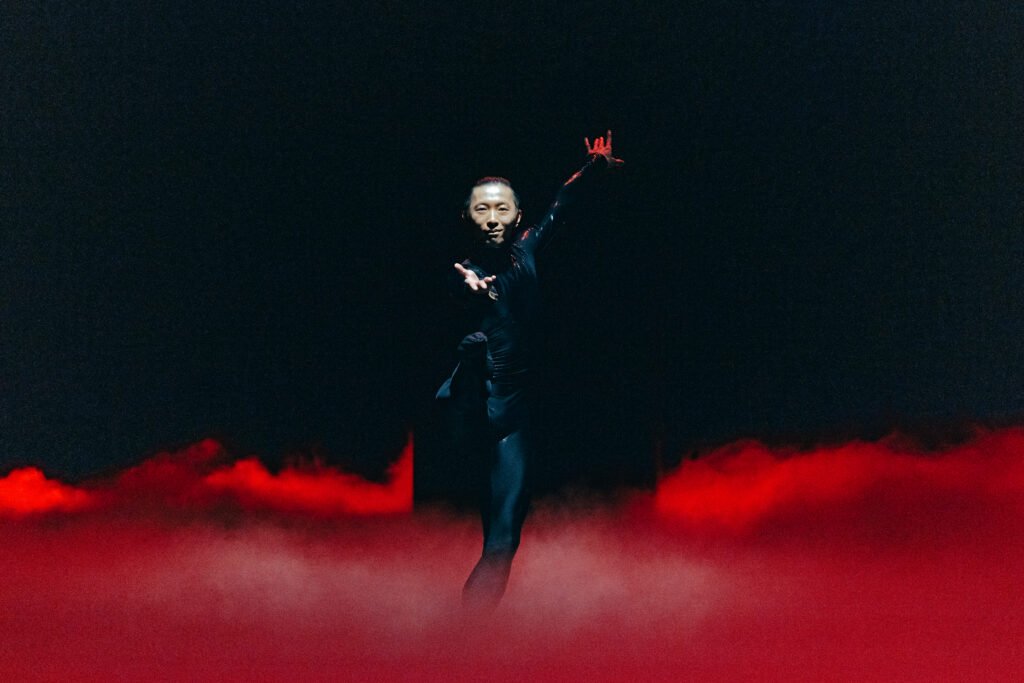
The ballet opens with Wei Wang as Hope, and from the first moments it is clear why the role belongs to him. Hope, in Mere Mortals, is not decorative. It is what remains after everything else has already been released into the world, and Wang carries it without pushing it outward. He begins the piece and he ends it, and in between, his presence becomes something you keep returning to, because he holds the center both conceptually and dramaturgically.
He has had a past couple of seasons that reframes range entirely, not as variation, but as transformation. One night he is princely, another grotesque, another a warrior, and here he becomes something quieter and harder to sustain. The technique is there, but what holds your attention is the consistency of his intention. He embodies hope as much as he sustains it.
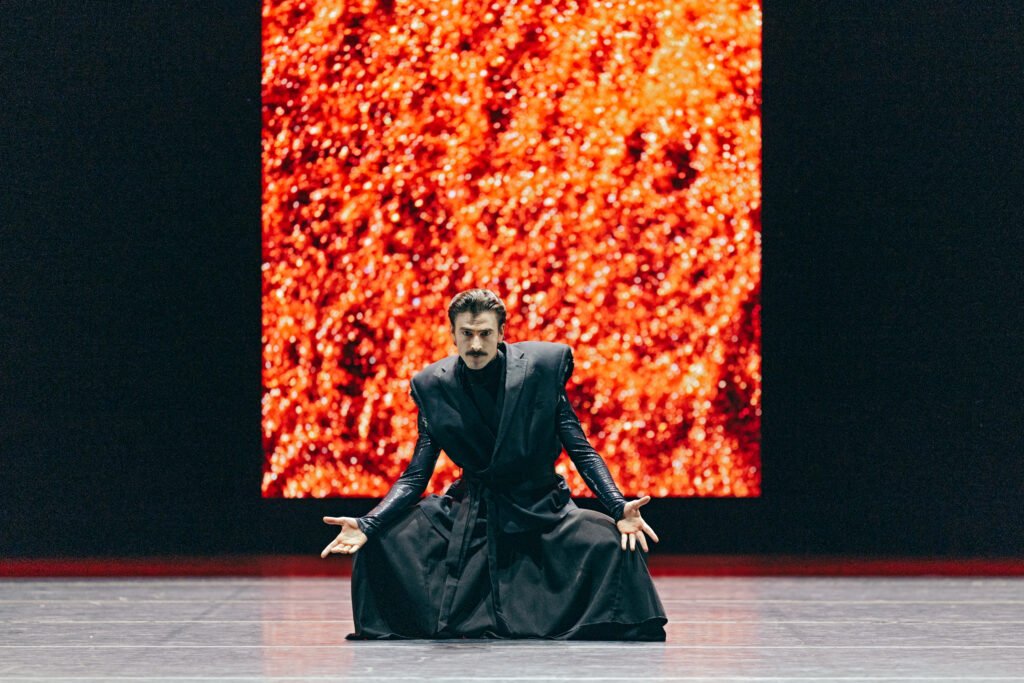
Joseph Walsh follows as Prometheus and shifts the entire energy of the piece. Where Wang harmonizes and stabilizes, Walsh pushes and drives forward with torque. There is a constant sense of momentum to what he’s doing, like he’s already in motion before the choreography catches up to him. It never feels cautious but rather it feels chosen, like there is something almost playful in the danger with full confidence in pushing things further than they should go. He leans into that character and motion fully.
A stand out performance from Corps member Parker Garrison as Epimetheus becomes the impressive counterweight that keeps that energy from tipping too far out. He grounds the entire opera house without dulling it, keeping something both passionate and recognizably human in the middle of all that forward drive, and that balance matters.
The exchange among Pandora, Prometheus, and Epimetheus becomes one of the most compelling sections of the ballet, the way they move around each other, repel, return, circle, collide, like atoms swirling around each other, like elements trying to exist in the same space without breaking it apart, and inside that tension something unexpectedly intimate emerges. It doesn’t feel decorative or choreographed for effect, it feels like pressure, like something is actively being negotiated among them in real time, and that’s where the piece sharpens, because you stop watching three roles and start watching three forces trying to coexist without collapsing each other.
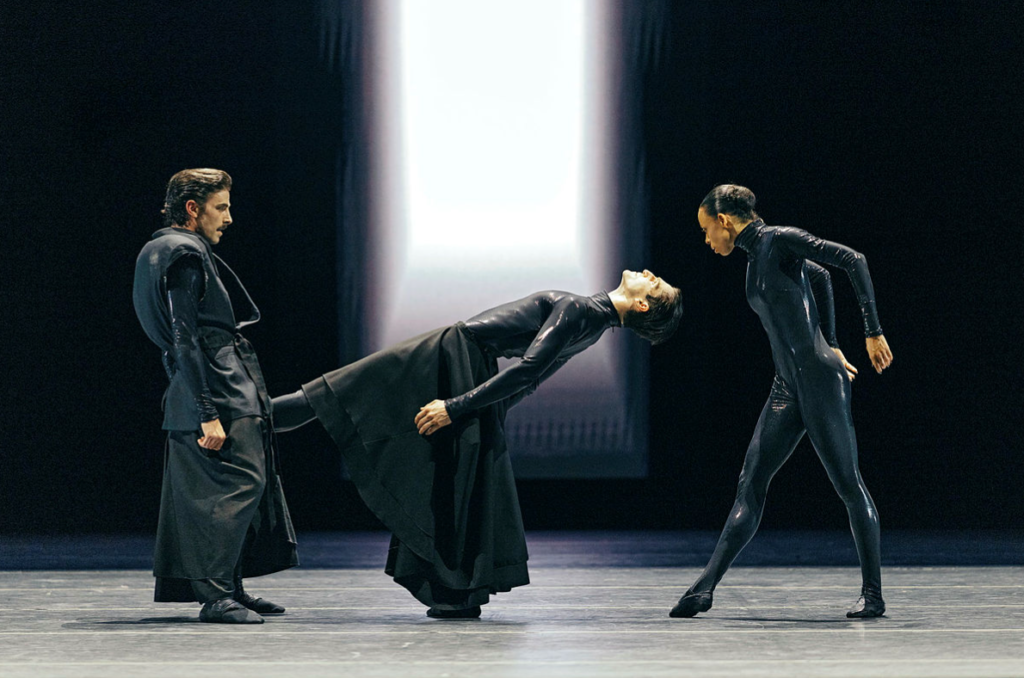
And then when the stage clears and Nikisha Fogo walks on, everything changes.
As Pandora, she delivers one of the most arresting solos I have seen at San Francisco Ballet, not just because it is designed to impress in obvious ways, however, but because it reveals something much more difficult to articulate.
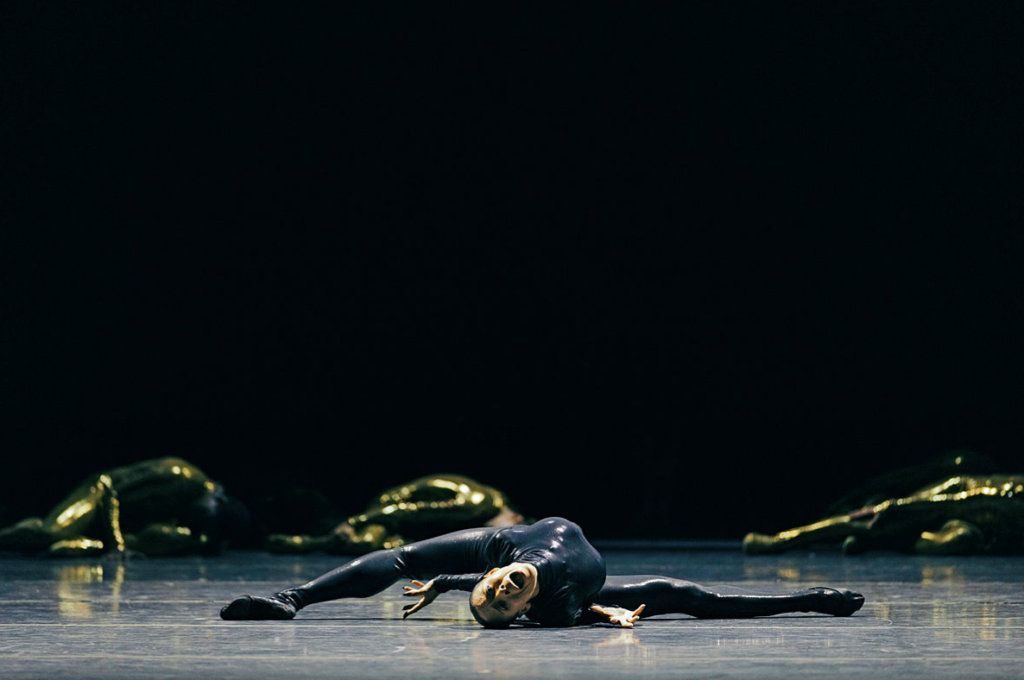
Fogo’s Pandora is not a woman entering a story rather than a woman awakening inside of one. Much of her choreography stays close to the floor, crouching, creeping, clawing, reaching, as if she is learning the architecture of her own body before she can understand the world around her. Every part of her is alive in the role, down to the smallest flicker of the eyelid. What she makes visible is not just her transformation, but her total, all engulfing exposure: a body processing pain, suffering, and agony at the same time as anger, rage, and vengeance, all of it moving through her at once without separation or relief, all for the first time ever in all of humanity. It is overwhelming in the truest sense of the word; not chaotic, but fully inhabited, every impulse carried through to its end to the very tips of her fingers.
Her flexibility, her command of contemporary movement, and her ability to let emotion travel cleanly through the body without exaggeration all converge into something that feels almost beyond human. There is a feral quality to it, but also confusion, hunger, discovery, a sense of being newly alive in a body that hasn’t settled yet. You’re not watching a finished character, what you are watching is something forming in real time. It is a breathtaking feat to witness.
And inside that, you start noticing the dancers differently, because when everything looks the same and there is nothing guiding your eye, you don’t follow rank, you follow instinct, and your eye keeps returning to the same dancers again and again. They are deliberately placed wherever they are because they take up space in the way the moment calls for it to be, and because something about their presence cuts through both the noise and the dense crowd of dancers onstage. In this production, for example, the burgeoning artistry of Apprentice AaliyahMarie Key, and the bold, grounded intensity of Soloist Carmela Mayo registered clearly as individual forces who’ll hold your attention without asking for it. Both ladies are without a doubt ones to keep an eye on in the upcoming 2026-27 season.
On an end note, it was also a genuinely nice surprise to see Demi Soloist Chuvas Thamires return after an injury, especially after being out for most of the season, and it leaves something to look forward to moving into the next.
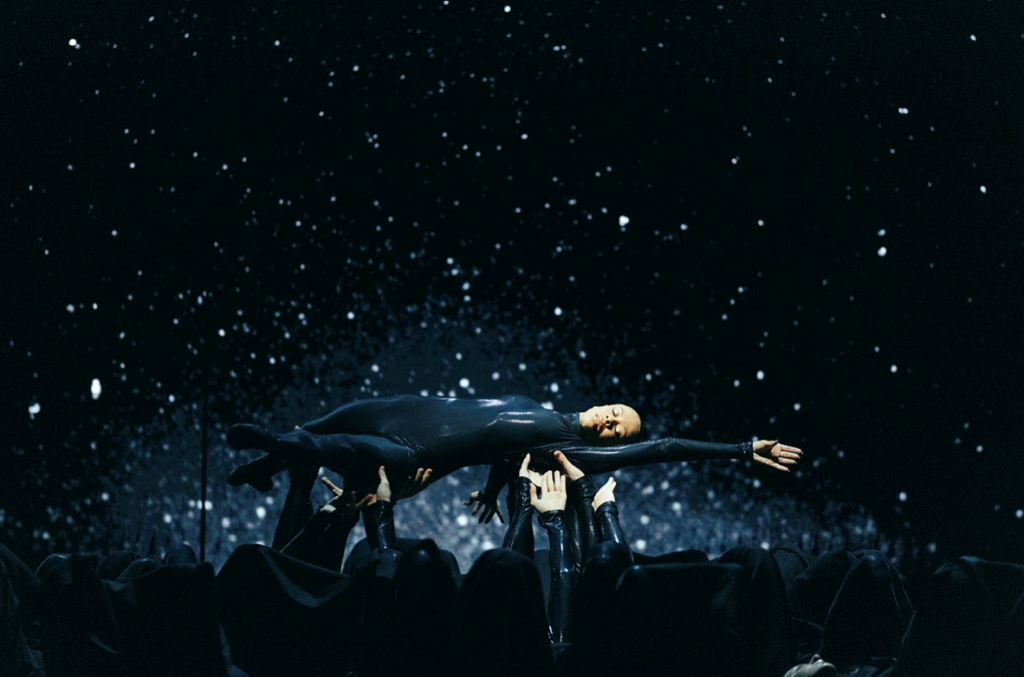
What Mere Mortals ultimately leaves behind has less to do with its structure or even its casting and more to do with recognition, because at a certain point you stop trying to read it as a ballet about mythology or technology or the future and you start recognizing something much more immediate, like the feeling of being inside your own life while it is actively unfolding, not in clean parts or in sequence but all at once, pain and joy and confusion and curiosity and anger and longing arriving simultaneously, overlapping, contradicting each other.
That is what this piece captures, not a narrative and not a warning but a condition, and watching it you realize that none of this is new, not the uncertainty, not the ambition, not the impulse to push forward without fully understanding what waits on the other side, these are human patterns, repeating, evolving, resurfacing.
And ballet, at its best, becomes a way of remembering that, a connective thread back through time, through people who have stood in similar moments and continued anyway. And that whatever holds us there, whatever keeps that motion intact, is enough.
For we are all mere mortals, after all.
“Hope humbly then; with trembling pinions soar;
Wait the great teacher Death; and God adore!
What future bliss, he gives not thee to know,
But gives that hope to be thy blessing now.
Hope springs eternal in the human breast:
Man never is, but always to be blest:
The soul, uneasy and confin’d from home,
Rests and expatiates in a life to come.“
– Alexander Pope
Mere Mortals runs through May 3rd. Stick around and enjoy a live DJ dance party activation in the lobby after the performance. Tickets are available right here.
Featured image credit: Lindsay Rallo
