
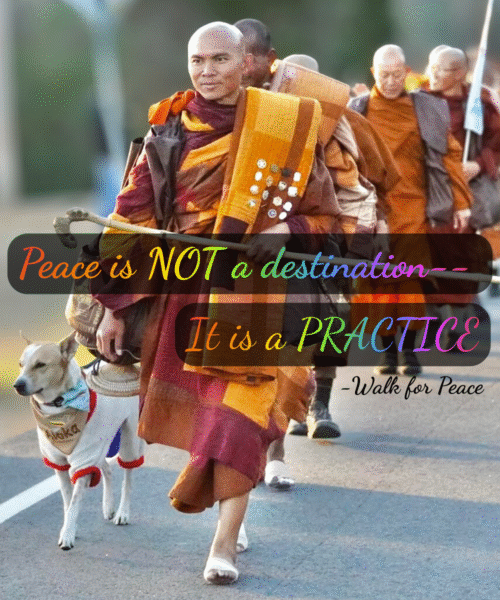
In a world that feels anything but peaceful, a group of Venerable monks—and their Peace Dog— have embarked on a civic and spiritual pilgrimage to remind Americans that “Peace is not a destination; it’s a practice.” The monks began their Walk for Peace in Fort Worth, Texas, on October 26 and expect to arrive in Washington, D.C., around mid‑February. Their 2,300‑mile journey will take roughly 120 days as they walk at a mindful pace through 10 states, offering a message of steadiness in a time when peace feels out of reach for so many.
The Meaning Behind the Miles
The Walk for Peace is both a spiritual journey for the monks and a public demonstration for everyone they encounter. In a year defined by noise, fear, and political volatility, their presence is a reminder that ordinary people can still choose peace and kindness over panic and harshness.
The walk is meant to “awaken the peace that already lives within each of us,” says the spiritual leader of the Walk for Peace, Venerable Bhikkhu Paññākara. He describes the pilgrimage as a living reminder that the unity and kindness within us radiate outward—to our families, our communities, and even to society as a whole.
The Walk’s Civic and Spiritual Weight
The monks are stopping in the capital city of each state they pass through, turning their walk into a civic act as much as a spiritual one. Walking slowly and silently to the steps of each capitol building is a way of saying, without confrontation:
“Peace belongs in public policy, not just private practice.”
Capitals are also where the widest cross‑section of people gather—residents, workers, activists, tourists—making the message accessible to more people. These stops place the monks on a symbolic stage, showing that stillness, humility, and moral clarity can interrupt the usual political noise with something radically different.
But some of the most moving moments come from the smaller communities along the way. The monks hold visiting hours twice per day—from 10:30 a.m. to 1 p.m. for lunch, and again from 6 p.m. to 9 p.m. in the evenings. At these stops, they share messages of mindfulness, loving‑kindness, and compassion with anyone who wishes to meet them.
They also document their journey daily on social media, sharing stories of the people they meet, the challenges they face, and the moments of connection that sustain them. Watching the crowds gather and reading the comments from people who have been deeply touched by their message is genuinely awe‑inspiring.
The Peace Dog at the Heart of the Journey
As a dog‑obsessed millennial, I can’t wrap this story up without talking about Aloka—the loyal Peace Dog, with a small heart-shaped patch of white fur right at his forehead—who has been walking with the monks from day one.
View this post on Instagram
Aloka was once a stray wandering the streets of India when he began following a group of monks on a similar peace walk. He stayed with them for more than 100 days and never left. His exact age and breed are unknown, but he’s estimated to be around four years old and is thought to be an Indian Pariah dog. He is, without question, a 100% good boy.
The Buddhist Principles Behind the Walk—and the Hope They Offer the LGBTQ+ Community
OFM spoke with TJ Dezauche in 2017 about the benefits of Buddhism and why the LGBTQ+ community should give it a chance. While Buddhist communities have responded differently to queer and trans identities across countries and centuries, modern Buddhism in the U.S. has grown more open, more curious and more welcoming over time. What makes Buddhism especially accessible to LGBTQ+ individuals is that it doesn’t require anyone to choose between their identity and their spiritual life. Instead, its core practices—mindfulness, compassion, and loving‑kindness—invite people to meet themselves honestly and gently.
For many queer people, that spaciousness matters. It creates a spiritual home where self‑understanding isn’t a threat but a doorway. And as the Walk for Peace moves across the country, the monks’ message echoes that same truth: Peace begins with seeing one another clearly, without fear, and without conditions.
In that way, the Walk for Peace becomes more than a pilgrimage; it becomes a living invitation. Each step the monks take models a kind of presence that queer and trans people are so often denied—a presence rooted in dignity, compassion, and the belief that every person deserves to meet themselves without fear. Their journey shows that peace isn’t passive or abstract; it’s something we cultivate in community, through small acts of recognition and care. And for LGBTQ+ people who are still searching for spaces that hold them fully, the Walk for Peace offers a reminder that those spaces can be built, tended, and walked toward together.
Follow the Walk for Peace on Social Media
If you want a daily dose of hope, the official Walk for Peace Facebook page is the easiest way to stay up to date. I first found them on TikTok, where they also post frequent updates. Their Facebook page includes an interactive map and daily route information, and Aloka even has his own Facebook and TikTok accounts so you can follow his part of the journey too.
Graphics courtesy of Walk for Peace