

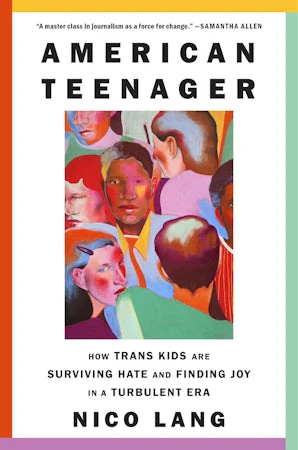
American Teenager: How Trans Kids Are Surviving Hate and Finding Joy in a Turbulent Era
Lots of media outlets have been dehumanizing transgender kids and have an opinion on how we should live. Within these news stories, there tend to be false statements. Nico Lang spent a year traveling the country to document the actual stories of transgender, nonbinary, and genderfluid teens and their families.
I was excited when Lang reached out to us asking if we would be interested in reviewing this book. Reading the stories of these eight teenagers as a transgender young adult who came out as a teenager, I felt less alone. Lang did an incredible job of capturing every single emotion. American Teenager shows the unknown, the beauty, the joy, the good and bad for transgender youth. It explains the battles we face when it comes to new anti-trans bills passing and how they affect one’s life. Each story is unique yet similar at the same time.
OFM had the chance to connect with Nico to hear about the writing process and more.
What inspired you to write a book like this?
I think this book has lived somewhere inside of me since I first pivoted to full-time LGBTQ+ reporting in 2016, recognizing the importance of queer storytelling in response to escalating attacks on our community’s very existence. I believe firmly in the power of education, and I thought that’s all it would take: replacing bad information with better information. But in order to educate others, we have to begin from a place of good faith, or else we aren’t going to get anywhere. In 2021, Texas introduced a bill that would have criminalized parents of trans youth as child abusers if they allowed their kids to transition, and I was floored by the inhumanity of it. I felt that it was critical to begin with the humanity of trans youth, and that’s what American Teenager is about.
It’s frankly depressing in 2024 that we have to keep explaining that trans people are people, and they deserve to be treated like it, but we can’t progress in the national discourse until that is a shared fact upon which we all can agree. These kids really are just that: children. They are treated like criminals and deviants, as if they are polluting their schools and playgrounds merely existing, but they are humans like the rest of us, trying to get by in the world. We must do what we can to make their path through this life a little easier, rather than continuing to burden them even further. Being a kid is hard enough; let’s not make it even harder.
What challenges did you face while writing this book?
Everything about this book was a challenge. As a reporter, it took every tool, skill, and resource that I had ever amassed throughout the course of my career. I had to be a journalist, a therapist, a social worker, and a community organizer. When you’re an LGBTQ+ writer, you have to do so much of the work yourself because people are going to close the door on you. One publishing house told us that the book wasn’t realistic because none of the families rejected their kids. I thought was a telling indication of the kinds of mindsets we were up against. LGBTQ+ authors are fighting this all the time, and we don’t always win.
How did you find these incredible teenagers?
I’ve been doing this work for a long time, so I knew several of the families already. Wyatt’s mother, Susan, leads a statewide trans advocacy group and has been a longtime source of mine. I came into contact with Rhydian’s family, and their warmth really stuck with me. Mykah I met at a summer camp for queer and trans youth in West Virginia.
I knew that we needed to include Florida and Texas because they have been pushing for anti-trans legislation. So I asked people in my networks to suggest parents and kids who had a story to tell. Ruby’s family offered an example of a boldly LGBTQ+ affirming religious family, a story we don’t hear about near enough. Jack and Augie’s family spoke to so many of the other challenges that trans kids are facing. I also included two AAPI stories, and I found them through recommendations from community groups. There hasn’t been nearly enough representation of trans-inclusive AAPI families, and I wanted to see that from this book.
Was there a moment during your writing process that particularly moved or inspired you?
One of the parts of writing this book that will stay with me forever was sharing space in Florida with Jack as she navigated the emotional fallout from her forced detransition. She was one of the trans youth who lost their access to healthcare when Florida revoked coverage of gender-affirming care for minors through Medicaid. She was 17 at the time and had to wait five long months to get her medication back.
What’s one thing you hope a reader takes away from this book?
I hope that readers fall in love with these kids’ stories and that they are able to see parts of their own experiences in their lives. I hope there will be recognition, understanding, and empathy. They should get to decide who they are and who they want to be in this world and to have the opportunities to walk that path. They should not have politicians trying to take away their freedom to lead self-determined lives—even something as little as being called by the right name and pronoun in school.
This book makes the stakes very clear: We can vote for a world that affirms and supports these kids, or we can vote for one that seeks to eradicate their very existence. The choice is ours, and I hope we make the right one.
Be sure to buy your copy of American Teenager today!
